
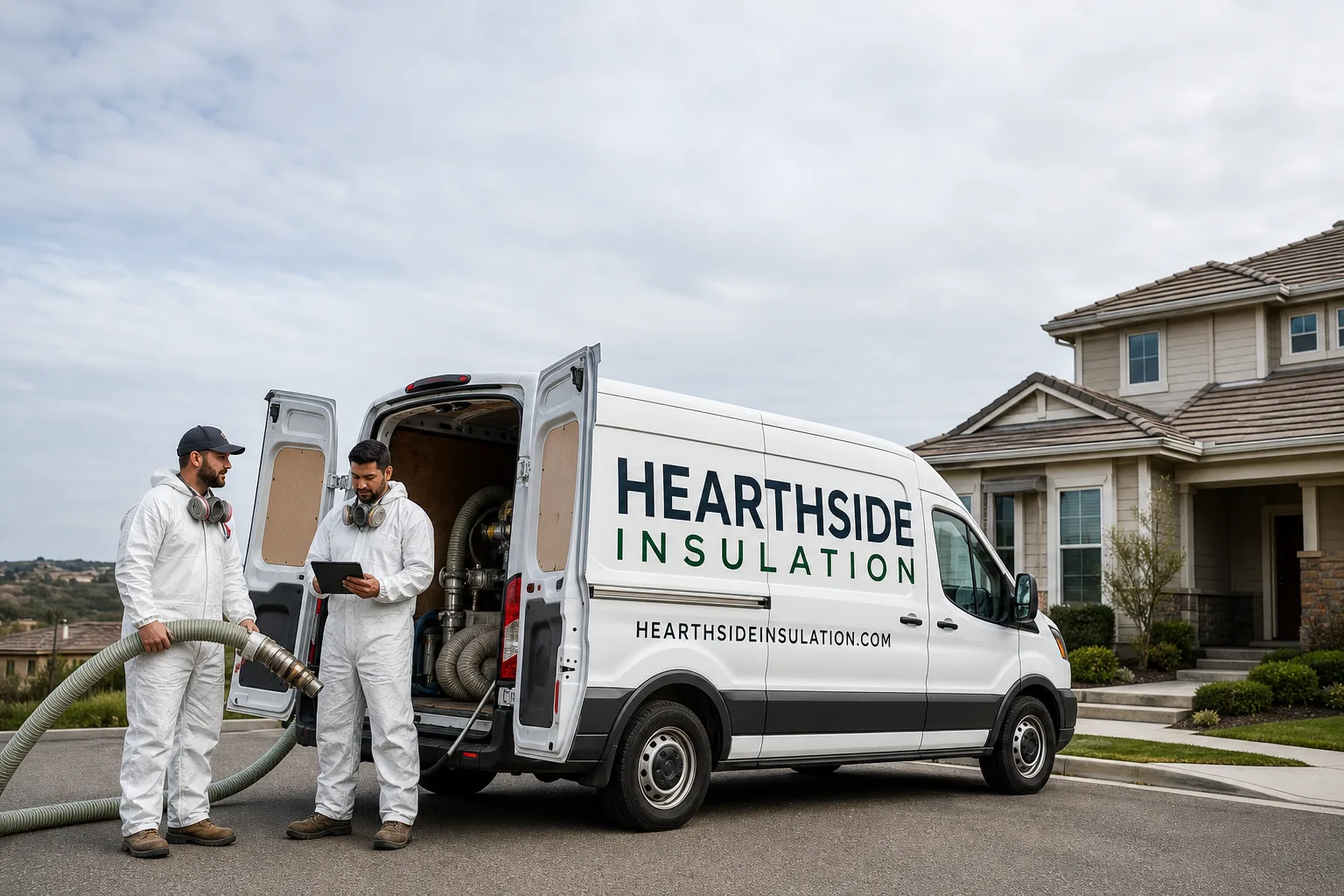
Fast, Reliable Attic Insulation Across Avocado Heights
Attic insulation in Avocado Heights typically runs $1,800 – $4,200 for a full top-up or replacement on a mid-century single-story home, and most jobs are completed in a single day. That’s the direct answer. What makes your house different from one in West Puente Valley or Hacienda Heights is the dust. The 91746 zip straddles Avocado Heights and the industrial edge of Industry, which means attics here pull in a volume of airborne grit that a typical San Gabriel Valley neighborhood never sees. We spec for that before we blow a single bag of fiber.
Hearthside Insulation is a dedicated insulation contractor. We don’t run attic jobs as a side service to an HVAC or roofing crew, and we don’t push one brand because it’s what’s on the truck. Trevor Bassett built the company around material-agnostic matching: eight brands, three methods, one specialist. That matters on older Avocado Heights houses where the right material depends on irregular framing, dust tolerance, and heat load, not a template.
Call (877) 265-4871 for a free estimate. We’ll walk the attic with you, show you what we’re seeing, and explain the material tradeoffs before you spend a dollar.
Key Takeaways
- Attic insulation for Avocado Heights homes runs $1,800 – $4,200 depending on footage, method, and current deck condition.
- Most 1940s – 1970s stucco homes here need air sealing and vent work before insulation, because conversion seams leak hot air and Industry-edge dust clogs soffits.
- Same-day and next-day scheduling is routinely available for Avocado Heights, and we carry GreenFiber, Owens Corning, and Knauf materials in local inventory.
Why Hearthside Insulation Is Avocado Heights’s Preferred Attic Insulation Company
The homes we work on in Avocado Heights are almost never new construction. They’re mid-century stucco ranches, many of them self-remodeled over several decades, with converted patios, enclosed garages, and add-ons built one project at a time. That produces attics with irregular joist spacing, dead air pockets, and framing that fights standard batt sizes. We know that before we open the hatch. Generalist crews show up with a flatbed of R-30 batts and force them into gaps they were never designed for. We don’t.
Our reputation here comes from solving what’s actually in the attic, not what’s on the estimate. Homeowners on the blocks off Proctor Avenue and around Durbin Street tell us the same thing: back rooms run 8 – 10 degrees hotter than the front of the house every August. That’s almost always a combination of dust-clogged soffit vents and unsealed conversion seams, not a missing layer of fiberglass. When a crew understands that before the first measurement, the fix lands differently.
Trevor Bassett’s team has worked this zip code long enough to know that Attic Insulation in Avocado Heights is a retrofit discipline, not a new-build line item. We schedule for same-week service across 91746, and we carry the materials to handle odd framing on the first visit, not a week later after a supplier order.
Insulation Contractors in Avocado Heights
Insulation contractors in Avocado Heights have to approach every job as a retrofit problem with a dust problem layered on top. A contractor who only knows how to lay batt over open joists will miss the real work: identifying where the attic is pulling hot exterior air and where the building envelope has cracked open. On these 1940s – 1970s stucco homes, the leaks are almost never in the stud walls. They’re at the garage and patio conversion seams, the places where a homeowner changed the footprint forty years ago and the envelope never got resealed.
Blown-In and Batt Matching to Odd Framing
When DIY add-ons create irregular joist bays, compressed batts leave gaps that run the thermal resistance down by half or more. We don’t guess at what fits. We measure the actual bay spacing and switch between GreenFiber blown cellulose and dense batt systems depending on what we find. A 14-inch bay gets one approach. A seven-inch bay with sloped roof shadowing gets another.
Dust-Resistant Air Sealing Before Insulation
Blowing insulation over a leaky, dusty deck just buries the problem under a fresh layer of fiber. Our crews air-seal first: conversion seams, top plates, plumbing and electrical penetrations. Then we screen the soffit vents so the next Industry-edge dust event doesn’t choke the airflow you just restored.
Attic Ventilation in Avocado Heights
Attic ventilation in Avocado Heights is not optional equipment; it’s the first repair most of these attics need. The San Gabriel Valley summer pushes attic temps past 130°F when the deck is baked under full radiant gain, and a dust-clogged soffit removes the only escape path that doesn’t rely on a powered fan. When vents choke, the whole attic becomes a heat exchanger running backwards, cooking the ceiling drywall and forcing the AC to fight a load that insulation alone can’t drop.
Soffit Screening and Rebalancing
We see more clogged soffits here than anywhere else in the San Gabriel Valley. That’s not chance. The 91746 edge against Industry and the equestrian lots on the east side put fine particulate airborne year-round, and older soffit designs have no screen to stop it. We rebalance intake and exhaust, then add screening rated for the dust load this specific geography produces.
Attic Baffles and Ventilation Prep
Mid-century construction in Avocado Heights often has minimal baffling, which means insulation gets pushed into contact with roof decking and chokes the eave vents from the inside. We install baffles and then prep the vent path before any material goes down. Insulation without ventilation delivers half its rated R-value in this climate. That’s a measurable fact, not a sales line.
On a small stucco ranch off Proctor Avenue backing an equestrian lot, our crew found a converted-garage seam leaking hot attic air into the living space and a dust-clogged soffit vent feeding the radiant gain. We screened and rebalanced the soffits, air-sealed the garage seam with Icynene foam, then blew GreenFiber over the existing joists to cut the 100°F-plus attic load. On a follow-up visit, we also handled a Reflectix repair in Avocado Heights for the same homeowner. The homeowner reported the back rooms finally tracking the front of the house on August afternoons.
Trusted Brands We Service in Avocado Heights
We’re authorized to install Owens Corning, Johns Manville, Knauf, Rockwool, CertainTeed, Icynene, Demilec, and GreenFiber, which means an Avocado Heights homeowner gets the right material for the actual conditions, not the one brand a single-line installer has left in the warehouse. Owens Corning fiberglass handles straight open-bay retrofits well. Knauf batts give us more fit options on irregular framing. GreenFiber cellulose settles into the odd cavities of a self-remodeled ranch without the gaps batt leaves behind. We’re a full Attic Insulation specialist, not a subcontractor picking up insulation work as an add-on, and that’s why we can stock local parts and materials for fast turnaround across Avocado Heights.
Common Attic Insulation Problems We See in Avocado Heights Homes
- Dust-clogged soffit vents. The Industry-edge parcels and equestrian lots feed a fine dust load that chokes older unscreened vents, strangling attic airflow and spiking summer deck temperatures. The insulation never gets a chance to work because the heat can’t leave.
- Garage and patio conversion seam leaks. These self-remodeled mid-century homes almost always leak at the conversion seams, not the walls. Hot attic air migrates into living space through cracks nobody has checked in decades.
- Irregular DIY framing defeats standard batts. Add-ons and owner-built extensions produce joist bays that aren’t 16 or 24 inches on center. Standard batt widths leave compressed edges and open gaps that cut effective R-value dramatically.
- No baffles, minimal vent path. Many original 1940s – 1970s attics in Avocado Heights have almost no baffling, so insulation pushes into the decking and blocks whatever vent path existed. The result is a hotter attic and a furnace that runs longer in the winter.
Pricing for Attic Insulation in Avocado Heights, CA
Here are real numbers for the Avocado Heights market, not a national template. A blown-in attic insulation top-up on a 1,200 – 1,500 sq ft mid-century home runs $1,800 – $2,600. Full replacement with air sealing runs $2,800 – $4,200. If we’re adding attic baffles and ventilation prep on a badly framed addition, expect that to add $400 – $800 depending on the vents. Dust-heavy jobs near the Industry edge need screen upgrades, typically $150 – $300. Factors that move the price: actual square footage, current insulation condition, seam count from conversions, and whether the soffits are salvageable or need rescreening. Estimates are free, and we don’t quote ranges from a website without looking at your attic first.
| Service | Avocado Heights Price Range |
|---|---|
| Attic Insulation Top-Up | $1,800 – $2,600 |
| Full Replacement with Air Sealing | $2,800 – $4,200 |
| Attic Baffles & Ventilation Prep | $400 – $800 extra |
| Dust Screen Upgrades for Soffits | $150 – $300 extra |
Call (877) 265-4871 for an exact quote on your Avocado Heights attic. The estimate is free and the number will be specific to your house, not a browser-generated range.
We Also Serve Cities Near Avocado Heights
Our service area covers the full 91746 edge and the surrounding San Gabriel Valley communities, including West Puente Valley, La Puente, Valinda, and Hacienda Heights. If you’re just outside Avocado Heights, we’re already working nearby and can schedule the same week.
Serving Avocado Heights, CA — Our Local Coverage Area
We’re based in the Avocado Heights area and know this community well. Use the map below to see our service coverage — if you’re nearby, we can almost certainly help.
FAQs About Attic Insulation in Avocado Heights
Yes. We spec dust-rated vent screening and air sealing before any blown insulation goes in, so the Industry-edge particulate stops choking your soffits and the insulation stays clean and effective. Call (877) 265-4871 for a free attic inspection – we’ll show you exactly where the dust is entering and what the fix costs.
In Avocado Heights mid-century ranches, the hot attic air leaks at the converted garage and patio seams, not the stud walls. Self-remodeled conversions rarely got proper envelope sealing when they were built, so that seam is the primary heat path into the living space. We air-seal it with Icynene foam before insulating, and the difference in the rooms adjacent to the conversion is measurable within the first hot weekend. Call (877) 265-4871 for an exact quote on sealing and insulation.
Yes. Irregular joist bays and no-gap cavities from owner-built add-ons are the standard here, not the exception. We measure the actual framing and switch between GreenFiber blown cellulose and Knauf or Owens Corning batts depending on what the bays will actually hold. That material-agnostic approach means you get honest fit, not forced product. Call (877) 265-4871 and we’ll map your framing before we quote anything.
Usually, yes. In Avocado Heights, the summer cooling load is the real problem, and an unventilated attic can hold 130°F-plus air against your ceiling all afternoon. Fixing ventilation and sealing leaks drops that heat load far more effectively than adding another layer of insulation on top of a broken system. We spec ventilation and air sealing first, then match the R-value to what the attic actually needs. Call (877) 265-4871 to have us evaluate what your attic needs first.
It does. The equestrian lots and nursery parcels around Avocado Heights generate fine organic dust that behaves differently from typical urban particulate, so we reach for blown cellulose like GreenFiber when the framing is irregular and the dust load demands a material that settles tightly into odd cavities. For straighter, open attics, Owens Corning or Knauf fiberglass batt handles the job cleanly. We match the brand to the conditions, not the other way around. Call (877) 265-4871 for a material recommendation based on your actual attic, not a sales sheet.
Written by Trevor Bassett, Owner at Hearthside Insulation, serving Avocado Heights and the San Gabriel Valley.