
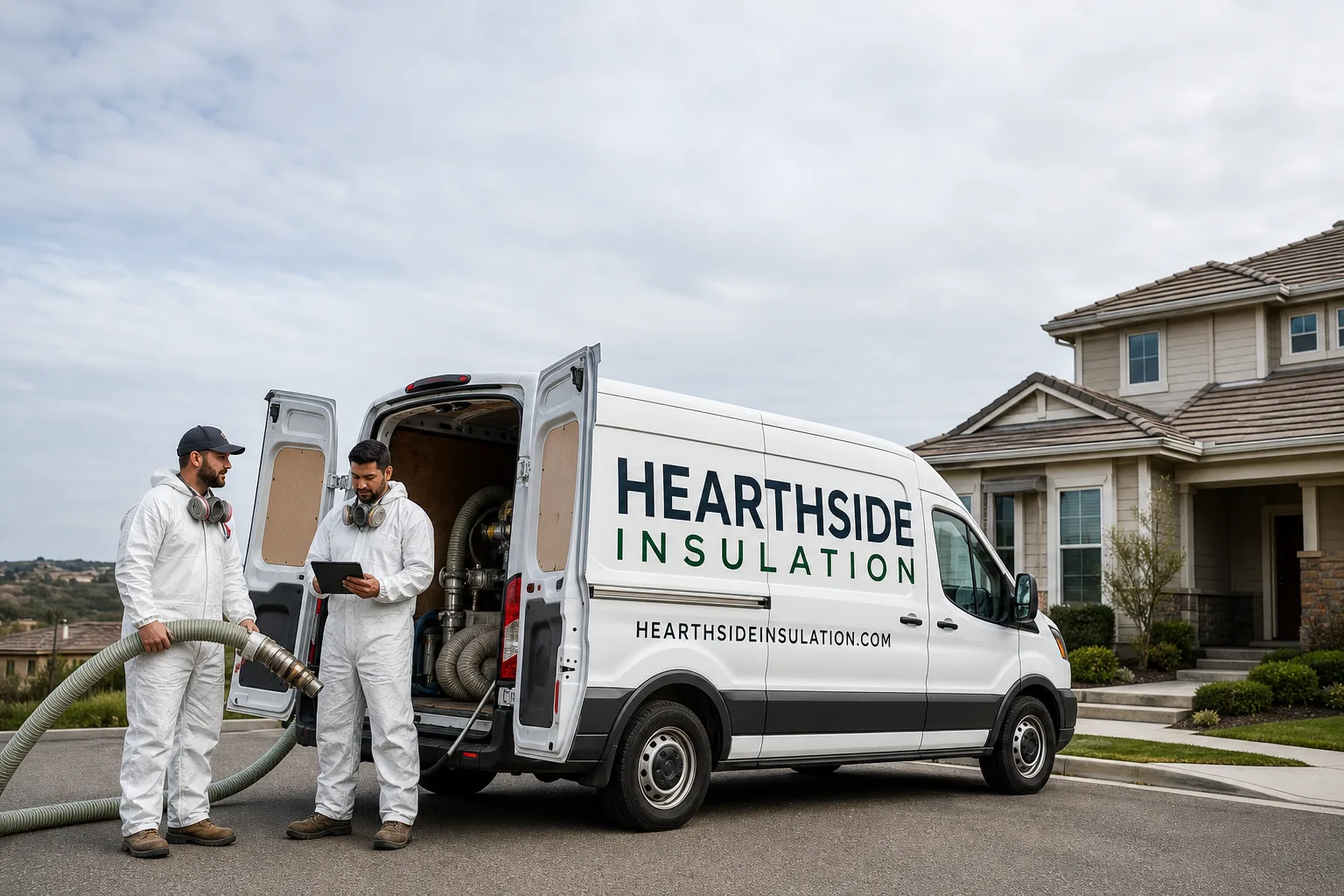
Fast, Reliable Attic Insulation Across Huntington Beach
Attic insulation in Huntington Beach typically costs $1.40 – $2.80 per square foot for blown-in fiberglass or cellulose, with a standard 1,200-sq-ft attic running $1,700 – $3,400 before any air-sealing or ventilation work. Most jobs are completed in a single day. Hearthside Insulation works throughout the 92615, 92646, 92647, and 92648 ZIPs, and we know how the marine layer near Pacific Coast Highway changes what belongs in an attic versus a house in Fountain Valley. Call (877) 265-4871 and we’ll give you an honest read on what your attic actually needs.
We’re not a general contractor running insulation on the side. We’re a dedicated Attic Insulation specialist with eight brands on the truck and no reason to push a product that doesn’t match your house. In Huntington Beach, that matters more than most homeowners realize, because the moisture rules here are different.
Why Hearthside Insulation Is Huntington Beach’s Preferred Attic Insulation Company
Trevor Bassett built Hearthside Insulation around a simple idea: match the material to the application, not the other way around. That’s why we carry Owens Corning, Johns Manville, Knauf, Rockwool, CertainTeed, Icynene, Demilec, and GreenFiber instead of selling whatever single line the distributor gives us. A 1950s tract home in southeast Huntington Beach and a 1990s two-story near Edison High School need different things. We stock both.
Huntington Beach homeowners call us because the marine layer makes insulation failures here specific. You don’t just lose R-value. You get damp batts, compressed fiberglass under a west-facing roof deck, and garage-conversion drywall that blisters in a single winter. We’ve seen enough of those to know exactly where to look, and we don’t upsell you into a fix that ignores the root problem. When a homeowner in the 92646 tracts calls about a “roof leak” that’s actually a vapor-control failure in a converted garage, we tell them before we quote. That honesty is why our local reputation keeps growing.
We typically schedule Huntington Beach jobs within three to five business days, and emergency work for water-damaged or moldy attic insulation can often be same-week. Our installers know the difference between a 92648 beach cottage attic with salt-air corroded vents and a track house off Goldenwest Street. That local familiarity means fewer surprises mid-job and a final result that holds up through the next fog season.
Insulation Contractors in Huntington Beach
Insulation contractors in Huntington Beach handle what general building crews often miss: the specific interaction between coastal humidity, attic airflow, and the insulation material itself. When you hire Hearthside for attic work in Huntington Beach, we inspect the existing batts, check for moisture damage from the marine layer, verify your soffit vents aren’t blocked, and then recommend either a top-up, a full removal and replacement, or a conversion from batts to blown-in loose-fill. Most residential attic projects here run $1,400 – $3,800 depending on square footage and whether the old material has to be pulled out first.
Huntington Beach Attic Top-Up Work
Many 1950s – 1970s tract homes around Newland Street and Ellis Avenue still have their original R-11 or R-19 fiberglass batts. Those batts compress under their own weight once they absorb marine-layer humidity, and the effective R-value drops well below what the label says. A top-up brings the attic to R-38 or R-49 without a full tear-out, and for most single-story HB homes that’s the right call.
Full Attic Replacement Jobs
When old insulation is moldy, insect-infested, or so compressed that it’s basically a thermal blanket for the ceiling, we remove it and start clean. In Huntington Beach we frequently find rodent damage in attics near the wetlands at Bolsa Chica, and damaged insulation has to go before new material goes in. Replacement costs more than a top-up, but it’s the only honest option when the existing material has failed.
Attic Ventilation in Huntington Beach
Attic ventilation in Huntington Beach does a different job than it does ten miles inland. The onshore flow keeps outdoor air damp for long stretches, so your attic needs enough airflow to dry itself out, not just to shed summer heat. Hearthside installs soffit baffles, ridge vents, and gable vents sized for Huntington Beach’s specific load: high humidity in June and July, then brutal afternoon sun on west-facing roof planes when the marine layer burns off. Ventilation work usually runs $350 – $1,200 depending on the number of vents and whether baffles need retrofitting into existing soffits.
Baffle Installation and Soffit Unblocking
We regularly open Huntington Beach attics and find the soffit vents buried under blown-in insulation or the paper facing of old batts. Once the soffit path is blocked, moist air has nowhere to go and the underside of the roof deck starts sweating. Installing baffles at every rafter bay and clearing the intake path is one of the highest-return ventilation fixes we do.
Ridge and Gable Vent Retrofit
Many mid-century Huntington Beach homes have gable vents but no ridge vent, or vice versa. In our coastal climate, balanced intake and exhaust matters more than total vent count. We’ll check the net free vent area against the attic square footage and add what’s actually missing, not what’s easy to sell.
Trusted Brands We Service in Huntington Beach
We’re authorized to install Johns Manville, Knauf, and Rockwool insulation in Huntington Beach, along with CertainTeed and the rest of our eight-brand portfolio. Having Johns Manville and Knauf fiberglass on hand means we’re not stuck spec’ing a single product line when a homeowner needs a specific R-value or a particular batt width. Rockwool mineral wool is a frequent request from Huntington Beach residents near the wetlands who want moisture tolerance and sound attenuation in addition to thermal performance, and some of those same homeowners also ask about Reflectix repair in Huntington Beach for radiant barrier work in their attics. We keep materials staged locally so Huntington Beach jobs don’t wait on a warehouse shipment from the Inland Empire.
Common Attic Insulation Problems We See in Huntington Beach Homes
- Marine-layer moisture soaking original fiberglass batts. Homes built in the 1950s through 1970s along the 92646 and 92647 tracts still have their first-generation batts, and decades of fog-season humidity have compressed them into a fraction of their rated R-value.
- Garage-conversion drywall blistering from missing vapor retarders. Previous owners stuff the stud bays, drywall over it, and the first damp winter turns the wall into a sponge. The drywall blisters, and the owner thinks the roof is leaking. It’s almost always vapor, not water intrusion.
- Blocked soffit vents trapping moist air under the roof deck. Blown-in insulation or batt paper covers the intake vents, condensation forms on the roof deck, and the ceiling shows water stains even though the shingles are fine.
- Salt-air corrosion on vent hardware and fasteners. In the 92648 and 92649 ZIPs close to the ocean, metal vent screens and fasteners rust through years earlier than inland. We replace corroded hardware when we do any attic work in those neighborhoods.
How Huntington Beach’s Coastal Climate Changes the Attic Insulation Job
Here’s what sets Huntington Beach apart from every inland job we do. The marine layer keeps attic wood and insulation damp for weeks at a time, and when the sun burns through, a west-facing roof hits 140°F before noon. That combination, sustained dampness followed by high heat, attacks insulation in ways a dry inland attic never sees. Fiberglass batts that stay soggy from roof leaks or from missing vapor retarders compress and grow mold. Once the batt structure collapses, the R-value drops and the insulation stops functioning as anything except a place for moisture to hide. An inland-spec install, no vapor retarder, basic venting, single-brand batts, fails in Huntington Beach. It doesn’t fail immediately, but give it a few fog seasons and a hot summer, and the homeowner is calling us about ceiling stains or a bedroom that won’t hold temperature.
In the 92646 – 92647 tracts, we opened a garage-conversion ceiling that the owner had stuffed with fiberglass and drywalled over with no vapor barrier. The first damp winter, the drywall blistered and they thought the roof was leaking. We pulled the wet batts, dried the bays, installed a proper vapor retarder, and blew in Owens Corning AttiCat to R-38 with baffles to keep the soffit vents open. The blisters stopped and the attic stayed dry through the next marine-layer cycle. That job wasn’t about adding more insulation. It was about installing the right assembly for a coastal climate, and that’s the difference a specialist brings.
Salt air complicates it further in the 92648 and 92649 ZIPs near the water. Vent screens, fasteners, and any exposed metal corrode years faster than they do off Goldenwest Street. When we evaluate an ocean-close attic, we check the vent hardware and account for corrosion-driven airflow loss as part of the insulation plan. You can’t just top off the R-value and walk away.
Pricing for Attic Insulation in Huntington Beach, CA
For a typical single-story Huntington Beach home, a blown-in fiberglass or cellulose top-up to R-38 runs $1,400 – $1,900 for a 1,000-sq-ft attic. A full removal and replacement of failed batts lands between $2,200 and $3,800 depending on attic size, access, and whether mold remediation is needed before new material goes in. Ventilation add-ons like soffit baffles or a ridge vent retrofit run $350 – $1,200. What moves the price in Huntington Beach specifically is the moisture factor: if old insulation is wet or moldy, removal costs more than a clean top-up because the material has to be bagged and hauled differently. We give free written estimates, and the price we quote is the price you pay unless we find a condition that changes the scope.
We Also Serve Cities Near Huntington Beach
In addition to our Huntington Beach work, Hearthside Insulation serves Attic Insulation customers in Midway City, Fountain Valley, Westminster, and Costa Mesa. Our Foothill Ranch location keeps drive times short to the whole coastal corridor, and we know how to adjust the same insulation assembly for slightly different humidity and housing stock as you move inland from the 92648 beach grid toward the 92708 tracts.
Serving Huntington Beach, CA — Our Local Coverage Area
We’re based in the Huntington Beach area and know this community well. Use the map below to see our service coverage — if you’re nearby, we can almost certainly help.
FAQs About Attic Insulation in Huntington Beach
A vapor retarder is necessary in Huntington Beach’s coastal ZIPs because the marine layer keeps outdoor humidity high for long stretches, and indoor moisture from showers and cooking gets pulled toward the attic. Without a retarder, that moisture condenses inside the insulation and the drywall beneath it. Inland homes with lower ambient humidity can sometimes skip the retarder without causing problems. In 92646, 92647, and 92648, skipping it is how you get blistered drywall and moldy batts in a single winter. Call (877) 265-4871 and we’ll tell you whether your attic assembly has the vapor control it needs.
In our experience with 92646 garage conversions, it’s almost never the roof. It’s moisture from warm interior air hitting a cold, uninsulated or incorrectly-insulated wall cavity with no vapor retarder. The drywall blisters when the trapped moisture tries to escape. A roof leak shows up as a localized stain that spreads from a penetration point. Blistering across the surface of the drywall points to condensation. We can open a small inspection area and tell you definitively, then fix it with a proper vapor retarder and the right insulation for the assembly.
For a west-facing Huntington Beach attic, we recommend raising the insulation to R-38 or higher with blown-in fiberglass or cellulose, and pairing it with active ventilation improvements, specifically soffit baffles and a ridge vent sized for the attic’s square footage. The marine layer delivers the moisture, and the afternoon sun delivers the heat; the combination requires both thermal resistance and consistent airflow. Rockwool is a strong option for homeowners who also want moisture tolerance and sound attenuation in that west-facing attic space.
Yes, in many cases we can insulate a converted garage or ADU in Huntington Beach without removing the drywall by using a dense-pack injection method into the stud bays. This works best when the existing drywall is sound and the bay cavities are clear. If the drywall is already blistering or the old insulation is wet, those sections have to come out for proper remediation. We’ll inspect the specific conversion and tell you which approach fits, and we won’t cut corners to save a day when the moisture issue hasn’t been addressed first.
Salt air in the 92648 and 92649 ZIPs accelerates corrosion on attic vent screens, fasteners, and any exposed metal brackets near the roof deck. When vent hardware corrodes, airflow drops, and the attic can’t dry itself out, which then compromises the insulation from a moisture standpoint. We check vent hardware as part of every ocean-close Huntington Beach insulation job and replace corroded components when we find them. If you’re within a mile of the water, budget a small allowance for vent hardware replacement alongside your insulation work.
Get Your Huntington Beach Attic Fixed Right
If your attic insulation is wet, compressed, or just not doing its job anymore, don’t wait for the next marine-layer cycle to make it worse. Hearthside Insulation serves all of Huntington Beach with free written estimates and honest recommendations. We’ll tell you what’s actually wrong, which material fits, and what it costs. Call (877) 265-4871 today and get on the schedule.
Written by Trevor Bassett, Owner at Hearthside Insulation, serving Huntington Beach and the Orange County coast.