
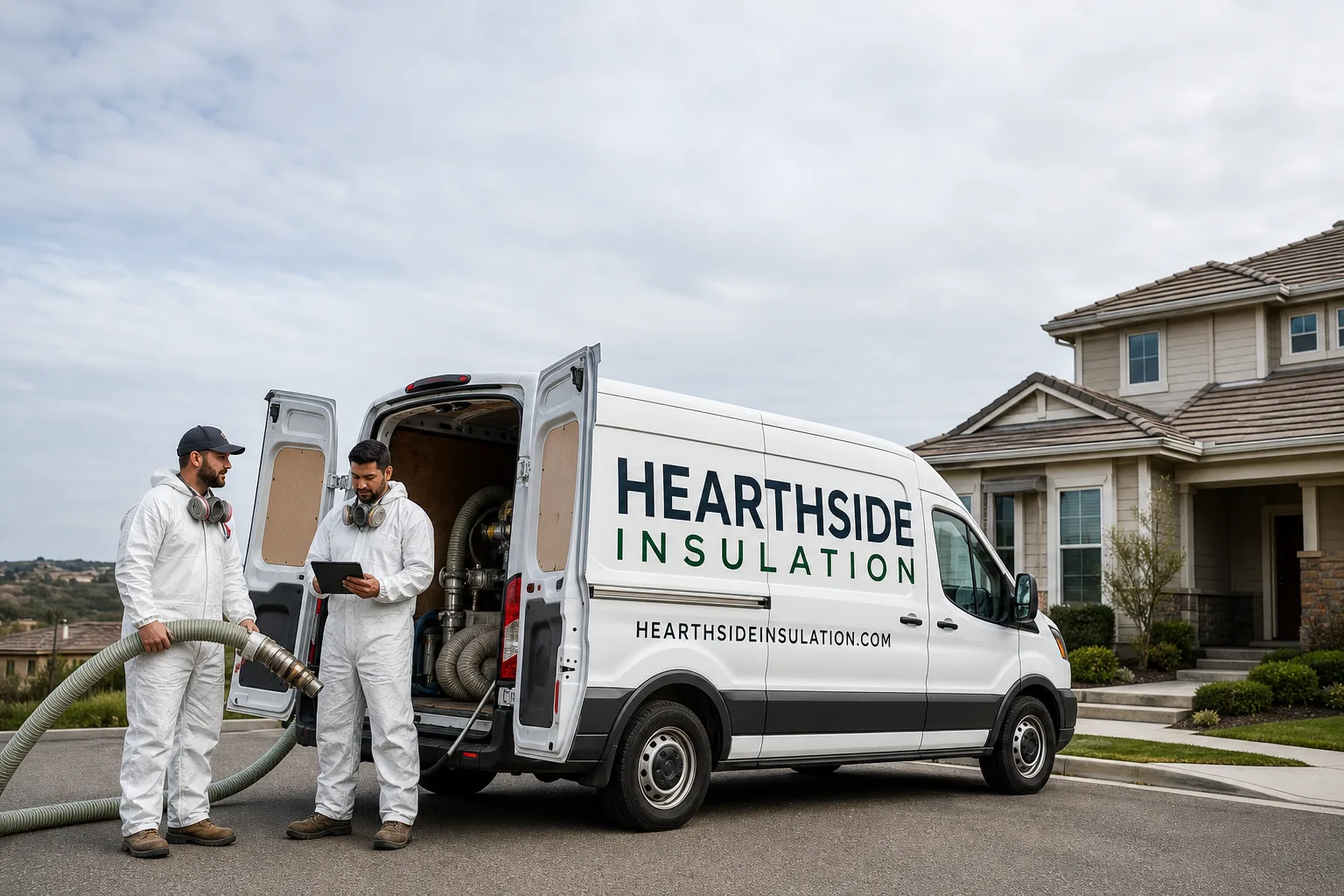
Fast, Reliable Attic Insulation Across Pico Rivera
Attic insulation in Pico Rivera costs $1,800 – $4,600 for a typical 1,200 – 1,600 sq ft single-story home, with removal and air-sealing adding $900 – $2,200 depending on access and wiring conditions. Most projects finish in one day, though homes with knob-and-tube wiring or settled blown-in material may need two. We’re in Pico Rivera weekly, and we know these 1950s tract homes well enough to quote accurately over the phone. Call (877) 265-4871 and Trevor Bassett will walk you through what your attic actually needs, not what a generic estimate says it needs.
Pico Rivera’s housing stock has a specific problem set. Original R-11 fiberglass or settled cellulose, attic temperatures that push past 130°F in July, and plaster ceilings that telegraph every thermal gap. That’s the work we do here. The block between Passons and Rosemead, the streets off Washington, the neighborhoods feeding into Rivera Park and Smith Park – those attics are full of insulation installed when Eisenhower was president and never touched since.
Key Takeaways:
- Most Pico Rivera attics have R-11 or less; current code recommends R-38 to R-49 for this climate zone
- River-adjacent homes along the Rio Hondo corridor settle unevenly, creating hot spots that need targeted removal and reinstallation
- We work around knob-and-tube wiring safely, which many insulation crews won’t touch
- Free estimates with no pressure; Trevor gives you the material-agnostic truth on every job
Why Hearthside Insulation Is Pico Rivera’s Preferred Attic Insulation Company
We’re a dedicated insulation contractor – not an HVAC shop that does insulation on the side. That focus matters in Pico Rivera, where attics from the 1950s and 60s need someone who understands old framing, plaster ceilings, and legacy wiring. Trevor Bassett has walked hundreds of attics across 90660, 90661, and 90662. He knows which stucco tract models on which streets have scuttle holes in the hallway ceiling versus a pull-down ladder in the garage. That’s not trivia; it’s how you price a job correctly the first time.
We carry Owens Corning, Johns Manville, and GreenFiber product lines, so we’re not stuck pushing one material because it’s all we stock. When a Pico Rivera homeowner needs R-38 batts under rafters, we install that. When a river-adjacent home needs blown-in cellulose that can be dense-packed around odd framing, we do that instead. The material matches the house, not our inventory.
Response time to Pico Rivera runs same-day for emergency estimates and within three to five business days for scheduled installation depending on season. Summer fills up fast, so if you’re sweating through August in a 1954 stucco home, call sooner rather than later.
Attic Insulation Removal in Pico Rivera
Attic Insulation Removal in Pico Rivera is a different job than it is in newer cities. In 90661 and 90662 especially, we’re pulling out original blown-in material that has settled, absorbed dust and rodent activity over six or seven decades, and in some cases was installed around knob-and-tube wiring without proper clearance. Removal on a typical 1,200 sq ft attic here runs $1,100 – $2,400, including bagging, HEPA vacuum extraction, and disposal. Homes with significant rodent contamination or asbestos-adjacent vermiculite run higher – we’ll flag that during the estimate and never surprise you later.
The Settling Problem Near the River Beds
Homes built on former agricultural land near the Rio Hondo and San Gabriel River beds experience foundation movement that most other parts of LA County don’t see. That movement doesn’t just crack driveways; it shifts framing enough that original blown-in insulation settles unevenly. The result is a living room that’s 8°F hotter than the bedrooms because the insulation over that section compacted to half its original depth. Removal and reinstallation solves it. Top-dressing over settled material does not.
Working Around Legacy Wiring
Knob-and-tube wiring is common in pre-1955 Pico Rivera tract homes. Old insulation was often blown right over it, which is both a code concern and a fire safety issue with certain materials. Our removal crews are trained to work around active knob-and-tube, leaving proper clearance so any new insulation – whether Owens Corning fiberglass or GreenFiber cellulose – is installed to current safety standards. If your wiring needs electrical work first, we’ll tell you before we quote the insulation.
Insulation Contractors in Pico Rivera
Insulation Contractors in Pico Rivera fall into two camps: generalists who will insulate your attic as one line item on a bigger remodel bid, and specialists who only do insulation, air-sealing, and thermal performance. We’re the second. For Pico Rivera’s post-WWII housing stock, that distinction shows up in the details – baffle installation that actually vents soffits, air-sealing around plaster cracks and recessed fixtures, and knowing which R-value makes sense for a house that leaks air through original single-pane windows. A full attic insulation replacement here runs $2,400 – $4,600 depending on square footage and material choice.
Retrofit Work in Tight Attics
1950s tract homes weren’t designed for easy attic access. Scuttle holes are small, roof pitches are low, and rafter spacing is often inconsistent. We send crews who know how to work efficiently in those conditions without trampling plaster ceilings. Batt installation in a tight Pico Rivera attic takes longer than in a newer McMansion with a walk-up attic – we account for that in our quotes instead of pretending every job is the same.
Property Managers and Builders
For property managers handling rentals across Pico Rivera and Downey, we provide written quotes with clear scope lines, before-and-after photos, and the same material-agnostic approach we give homeowners. Whether you need one unit topped up to R-38 or a fourplex completely re-insulated, Trevor coordinates scheduling so tenants aren’t disrupted more than necessary.
Trusted Brands We Service in Pico Rivera
We’re authorized to install products from eight manufacturers, and for Pico Rivera specifically we lean on Owens Corning fiberglass, Johns Manville batts, and GreenFiber cellulose most often. Attic Insulation work in this climate zone needs materials that hold their R-value through 130°F summer attics and damp winter mornings. Owens Corning R-38 batts are a common recommendation for the standard 2×6 rafter bays we see in 1950s construction. GreenFiber cellulose works well dense-packed into the odd framing cavities that come with older additions. We carry both on our trucks, along with Knauf products when a homeowner wants a value option that still meets code.
Common Attic Insulation Problems We See in Pico Rivera Homes
- Settled blown-in insulation near the Rio Hondo corridor: Foundation movement on former agricultural land compacts original cellulose or fiberglass, leaving 2-3 inch gaps over living areas. You’ll feel it as hot spots in the room below even when the rest of the house is comfortable.
- Original R-11 batts that have lost their loft: Six decades of 130°F attic heat degrades fiberglass binders and compresses batts to half their original thickness. R-11 effectively becomes R-5, which is almost no insulation by modern standards.
- Retrofit gaps around knob-and-tube wiring: When previous owners or contractors cut insulation around legacy wiring, they often leave wide uncompressed gaps. Those gaps act like thermal chimneys, pulling conditioned air out of the house year-round.
- Missing or crushed soffit baffles: Older Pico Rivera homes often have zero baffles or baffles that collapsed under blown-in material. Without proper soffit-to-ridge ventilation, summer attic heat has nowhere to go, and shingle life drops along with comfort.
On a 1952 stucco tract home near the Rio Hondo River bed, we found original blown-in insulation that had settled unevenly due to foundation movement on former agricultural land, leaving hot spots over the living room. Our crew removed the degraded material, air-sealed around knob-and-tube wiring, and installed Owens Corning R-38 batts under the rafters, working in 130°F attic heat. The homeowner reported a 20°F drop in peak afternoon room temperature.
Pricing for Attic Insulation in Pico Rivera, CA
Here’s what Pico Rivera homeowners should expect to pay in 2026:
- Attic insulation top-up (R-11 to R-38 blown-in): $1,200 – $1,800 for a standard 1,200 sq ft attic
- Full removal and replacement: $2,400 – $4,600 depending on material and access
- Attic batt insulation installation (new R-38): $2,000 – $3,800 for typical single-story homes
- Air-sealing package with insulation: Add $600 – $1,200 including can light covers, wire penetrations, and top plate sealing
- Attic baffles and ventilation prep: $400 – $900 depending on rafter bay count and soffit access
Homes in 90660 near the 605 often need more air-sealing than homes further east, simply because of wall-cavity gaps from original construction. We’ll show you where the money goes on the estimate. Call (877) 265-4871 for a free quote with no obligation.
We Also Serve Cities Near Pico Rivera
Our service area extends beyond Pico Rivera into the surrounding communities we’re already moving through daily: Attic Insulation in Pico Rivera, West Whittier-Los Nietos, Santa Fe Springs, Downey, and Whittier. If you’re on the edge of two service areas, call and we’ll tell you straight up which day our crew is closest to your block.
Serving Pico Rivera, CA — Our Local Coverage Area
We’re based in the Pico Rivera area and know this community well. Use the map below to see our service coverage — if you’re nearby, we can almost certainly help.
FAQs About Attic Insulation in Pico Rivera
Foundation movement on former agricultural land near the Rio Hondo and San Gabriel River beds shifts framing enough that original blown-in material compacts unevenly over time. You end up with 2-3 inch gaps over living spaces while other sections stay relatively full. Removal and reinstallation is the only real fix. Call (877) 265-4871 and Trevor can assess whether your settlement pattern is structural or insulation-specific.
Yes, with proper clearance and material selection. Our crews are trained to work around active knob-and-tube wiring, leaving the required air gap so new insulation doesn’t create a fire hazard. We’ll flag any wiring that should be addressed by an electrician before we insulate, but in most cases we can proceed without a separate electrical contractor.
R-38 to R-49 for vented attics, matching current California Title 24 requirements for this inland LA climate zone. Attic temperatures here exceed 130°F in summer, so R-38 is the minimum we recommend for any replacement job. If you’re topping up original R-11, we aim for R-38 as the practical sweet spot between cost and performance.
Foundation movement shifts the rafters and ceiling joists, which compacts blown-in insulation and creates uneven coverage. You’ll notice it as hot spots over rooms that sit above the areas of greatest movement – typically living rooms and front bedrooms. Re-leveling the foundation isn’t required to fix the insulation, but we do need to remove and reinstall rather than simply adding material on top.
Yes, full removal with HEPA vacuum extraction is one of our core services for Pico Rivera homes. We remove settled blown-in material, degraded fiberglass, and anything a previous owner left up there, then air-seal and install fresh insulation to current R-value standards. Removal on a typical 1,200 sq ft attic runs $1,100 – $2,400. Call (877) 265-4871 for an exact quote.
Ready to fix that hot attic? Call Hearthside Insulation at (877) 265-4871. Trevor Bassett answers his phone, asks the right questions about your home’s age and construction, and gives you a straight answer on cost and material. Free estimates, no pressure, and the right insulation match for the house you actually live in.
Written by Trevor Bassett, Owner at Hearthside Insulation, serving Pico Rivera since our first river-adjacent retrofit in the early 2000s.