
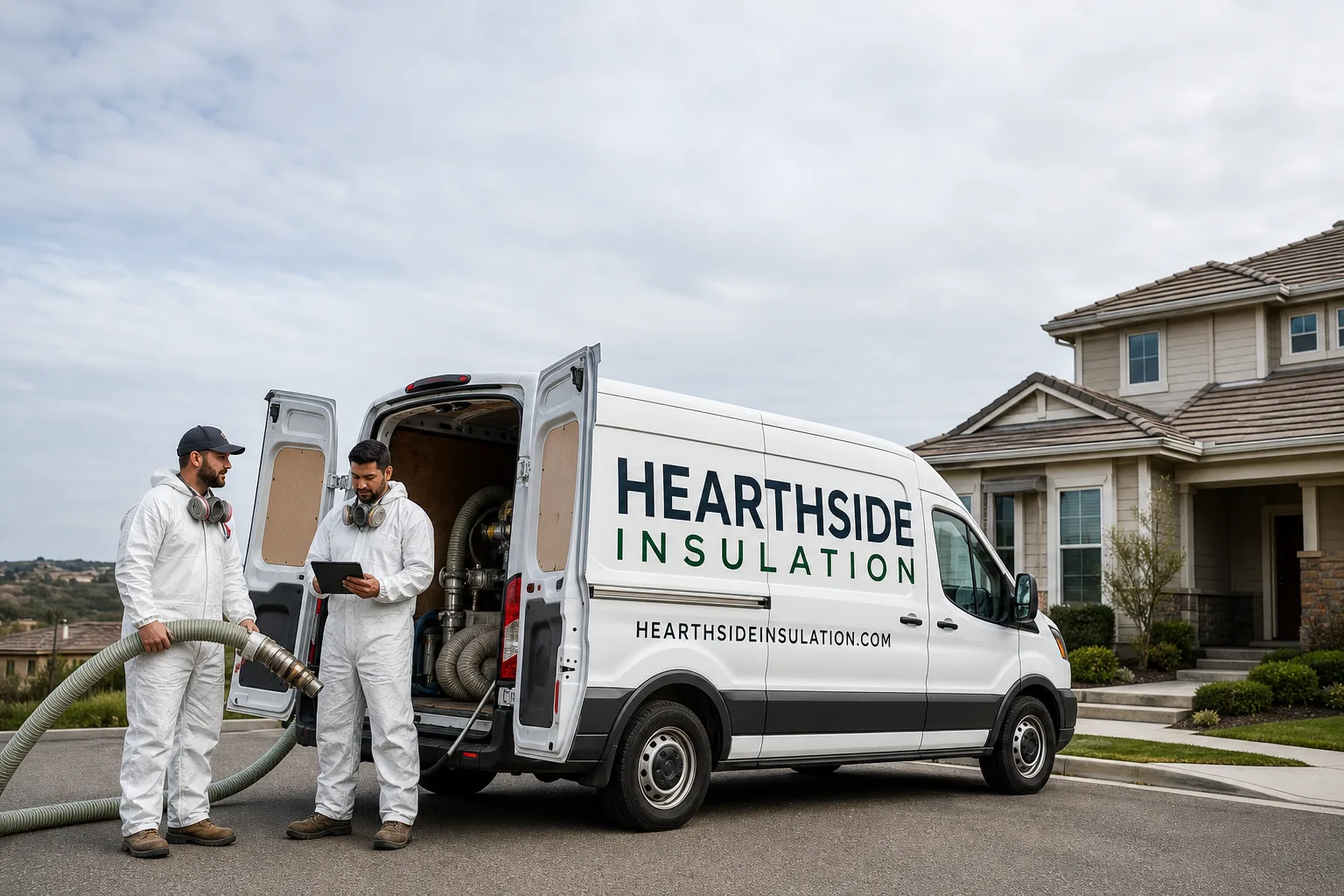
Fast, Reliable Spray Foam Insulation Across Downey
Spray foam insulation in Downey costs between $1,800 and $4,600 for a typical attic application, with rim joist and garage ceiling work running $800 to $2,200 depending on square footage and foam type. Most Downey jobs are completed in one day, though a full attic plus garage seal usually takes two. We’re based in Foothill Ranch and run crews into Downey zip codes 90239 through 90242 on a weekly schedule, so the response time is measured in days, not weeks. Call (877) 265-4871 and we’ll give you a straight answer on what your home actually needs.
Why Hearthside Insulation Is Downey’s Preferred Spray Foam Insulation Company
Most of the spray foam work we do in Downey is on homes built between 1945 and 1965, which means stucco siding, slab foundations, and attic spaces that were never designed for the heat loads they carry now. Homeowners who call us from neighborhoods like Furman Park, Stonewood, and the avenues east of Lakewood Boulevard aren’t usually calling about cold rooms. They’re calling because the second floor of a single-story tract home is running 8 or 10 degrees warmer than the rest of the house by 3 p.m. in July. That’s a garage-to-attic leak path feeding heat into the ceiling plane, and it’s a Downey problem specifically. Our crews know the housing stock because we’ve worked most of it.
Trevor Bassett built Hearthside Insulation around a single focus: insulation. Not HVAC, not roofing, not windows. That matters when you’re deciding whether open-cell or closed-cell foam belongs in a ceiling-vented attic over a 1958 ranch, because we’re not trying to sell you the one product we happen to stock. We install both Icynene and Demilec spray foam systems, which gives us an honest comparison point most single-line installers can’t offer. For Downey homes with the classic stucco-on-slab wall assembly, that comparison usually lands on closed-cell foam for the rim joist and garage wall plane, and open-cell for the attic underside when the ductwork lives up there. The material should match the application, not the other way around.
We also carry Johns Manville and Rockwool products for hybrid jobs where spray foam pairs with batts or mineral wool in specific cavities. That kind of flexibility matters in Downey, where some attics want full foam and others want foam plus a Rockwool thermal break over the top plate. Eight brands across fiberglass, mineral wool, spray foam, and cellulose means we don’t steer you toward a product because it’s the only one in the truck.
Spray Foam Insulation Contractors in Downey
Spray Foam Insulation contractors working in Downey need to understand one thing most general contractors miss: the rim joist and garage wall are part of the attic’s air boundary. On a stucco-on-slab tract home, hot air moves from the garage into the wall cavities, up into the attic, and across the ceiling plane. If you only insulate the attic floor, you’ve made the blanket thicker while leaving the window open. Our spray foam crews in Downey seal the pressure path at the source, then insulate the attic deck or floor depending on how the home’s ducts are configured.
Typical contractor-attended spray foam work in Downey runs $1,800 to $4,600 for the attic portion, with garage ceiling and rim joist sealing adding $800 to $2,200. The labor window is one to two days for most homes. We quote it as a fixed number after we look at the actual attic, not a range that shifts after the truck arrives.
Rim Joist and Garage Wall Sealing on Slab
Downey homes with slab foundations don’t have a crawlspace to flag air movement. The rim joist leaks hidden inside the garage wall cavities, and the stucco exterior hides what a pier-and-beam home would show as a draft. Closed-cell foam at the rim joist and garage ceiling plane stops the heat transfer at the point where it enters the attic.
Open-Cell vs. Closed-Cell Selection
In a vented Downey attic where the AC ducts run through the hot side of the insulation, closed-cell on the roofline is often the right call. In a separate attic floor application where ducts are buried or the attic is unconditioned, open-cell can hit the R-value target for less money. We carry both Icynene and Demilec systems, so the conversation is about which one fits the house, not which one we prefer.
Spray Foam Attic Insulation in Downey
Spray foam attic insulation in Downey’s aging post-war housing is usually a retrofit, not a new-construction job. The typical project involves a ceiling-vented attic over 900 to 1,400 square feet, with deteriorated original batts and garage-adjacent wall planes that never sealed correctly. The work runs $2,200 to $5,800 when combined with garage and rim joist sealing, and the difference between a good foam attic job and a bad one shows up on the second-story thermostat within a week.
The first thing we tell Downey homeowners is that foam can’t be sprayed over failed batts and called done. If closed-cell foam goes over compressed, dirty fiberglass, it traps moisture between the foam and the drywall below, and the R-value never stabilizes. We remove the old material, inspect the top plates and penetrations, then foam the air boundary correctly. If the home has attic ductwork, we’ll often recommend moving the thermal boundary to the roofline and bringing the ducts inside the conditioned space. It’s a bigger job, but in a Downey attic that hits 120°F or more in August, it’s the difference between an AC that cycles reasonably and one that runs from noon to sunset.
Second-Story Heat Problems in Single-Story Ranch Homes
A 1950s tract house in Downey should not have a second-story temperature problem unless the attic has been finished or the design includes a split-level core. What homeowners actually experience is heat radiating downward through the ceiling from an attic that’s overheated. When the ceiling plane is full of compressed 1960s batts and the garage wall plane leaks hot air, the living space below absorbs it. Sealing and foaming the attic stops that radiant heat load at the source.
Attic Ducts and the Foam Decision
If the home’s HVAC ducts are up in a vented attic, they’re running through 120°F air and losing a chunk of their cooling before it reaches the registers. Spray foam on the roofline brings the attic temperature down to within a few degrees of the living space, which reduces duct loss and shortens the compressor run time. For Downey homes with original metal ductwork still in place, this usually pays for itself faster than any other insulation upgrade available.
Trusted Brands We Service in Downey
Hearthside Insulation installs spray foam systems from Icynene and Demilec, plus Johns Manville and Knauf fiberglass when a hybrid attic calls for foam plus batt layers. We also stock Rockwool mineral wool for Downey homeowners who want added fire resistance and acoustic control in garage walls or ceiling cavities. Because we’re authorized across eight manufacturing lines, we keep parts and material lead times short for Downey crews. That means no two-week waits for a specific foam kit or batt size. The product selection is driven by what your attic and budget actually need, not by what a single-brand installer happens to carry.
Common Spray Foam Insulation Problems We See in Downey Homes
- Closed-cell foam sprayed over failed batts. Contractors who don’t remove decades-old fiberglass before foaming the attic floor create a moisture trap and an uneven R-value. The foam looks fine from the hatch, but the ceiling below reflects none of the benefit.
- Garage-to-attic leaks on stucco-on-slab homes. The rim joist and garage wall plane leak hot air into the attic even after an attic-only foam job. If the temperature upstairs doesn’t change after your first attic project, this is usually the reason.
- Open-cell foam applied too thin in a hot vented attic. Some installers spray open-cell at 3 or 4 inches when the target is 5.5 inches for the R-value spec. In a Downey attic that reaches 120°F, the shortfall shows up as persistent second-story heat that the original call was about.
- Foam over the top plate without sealing penetrations. Recessed light housings, wiring chases, and plumbing vents all leak air through the ceiling plane. Foam alone doesn’t fix those if the penetrations aren’t sealed first, so the attic keeps pulling conditioned air out of the house.
Pricing for Spray Foam Insulation in Downey, CA
A focused rim joist and garage ceiling spray foam job in Downey runs $800 to $2,200. An attic floor application with open-cell foam over approximately 1,000 square feet costs $1,800 to $3,400. A full roofline installation with closed-cell foam, typically 1,200 to 1,500 board feet, runs $3,200 to $5,800. Homes with attic ductwork that need the thermal boundary moved to the roofline total on the higher end of that range. The crew size and foam type shift the number, but the range above covers most Downey tract homes we quote. Call (877) 265-4871 and we’ll walk the attic with you, measure, and give you a fixed number. The estimate is free.
We Also Serve Cities Near Downey
Hearthside Insulation crews run from Foothill Ranch into Santa Fe Springs, Paramount, Pico Rivera, and Bellflower as part of the same weekly route that covers Downey. If you’re in one of those cities and need spray foam or attic work, the scheduling works the same way: call, we assess, we quote, we schedule. The distance doesn’t change the price, just the day we show up.
Serving Downey, CA — Our Local Coverage Area
We’re based in the Downey area and know this community well. Use the map below to see our service coverage — if you’re nearby, we can almost certainly help.
FAQs About Spray Foam Insulation in Downey
No. Spray foam should not be applied over failed or compressed original insulation in a Downey attic. The old material needs to come out first, otherwise the foam traps moisture between the new layer and the ceiling drywall, and the R-value never stabilizes. A proper job means removal, inspection of the top plates and penetrations, then foam on a clean surface. If a contractor tells you the old batts can stay, that’s a red flag. Call (877) 265-4871 and we’ll explain what your specific attic needs after a quick look.
In most Downey homes, the upstairs heat problem comes from the garage-to-attic air path, not the attic floor insulation level. Hot air moves from the garage into the wall cavities, up through the rim joist, and into the attic, where it pushes against the ceiling plane. Adding batts on the attic floor slows conductive heat but doesn’t stop the convective leak. We fix this by sealing the rim joist and garage wall plane with closed-cell foam before addressing the attic itself. If you’ve already added attic insulation and the problem didn’t change, that’s the clue.
Open-cell foam works in attic floor applications where the attic stays vented and ducts aren’t running through the hot zone. Closed-cell foam is the better choice for roofline applications and any area that needs an air and vapor barrier, like a rim joist or garage wall. In Downey, where summer attic temperatures consistently exceed 120°F, closed-cell on the roofline typically delivers better comfort and duct performance. We carry both Icynene and Demilec systems, so the recommendation is based on your home’s specific attic layout, not a brand preference.
Downey’s inland position means hotter afternoons than coastal neighbors like Bellflower or Long Beach, and that attic heat radiates through the ceiling plane for hours after the sun peaks. Closed-cell foam on the roofline creates a radiant barrier effect that open-cell on the attic floor doesn’t, so it’s often the better choice for homes where the upstairs rooms never cool down by evening. The heat is also why we recommend moving attic ductwork inside the conditioned space whenever possible. The energy savings compound over every 90°F day, which in Downey is most of July and August.
No, spray foam doesn’t cause duct problems, but it changes how the ducts function. If the attic is foamed at the roofline and the ducts are inside that conditioned space, they operate more efficiently because they’re not running through 120°F air anymore. If the attic is foamed at the floor and the ducts stay above the foam in the vented space, they’ll keep losing cooling the way they always have. The foam placement, not the foam itself, determines the duct performance. We assess duct location on every Downey attic we quote and factor it into the recommendation.
Contact Hearthside Insulation for Spray Foam in Downey
If your Downey home is fighting afternoon heat, uneven upstairs temperatures, or air that feels stale no matter what the thermostat says, call (877) 265-4871. We’ll schedule a walkthrough of your attic and garage, measure the actual spaces, and give you a fixed quote on spray foam work. No generic ranges after the fact, no upsell to products you don’t need. Just an honest read on what your home requires, from a crew that has worked plenty of Downey’s post-war tract homes and knows the classic failure points. The estimate is free and the phone call takes five minutes.
Written by Trevor Bassett, Owner at Hearthside Insulation, serving Downey and the surrounding communities with spray foam, attic, and blown-in insulation systems.