
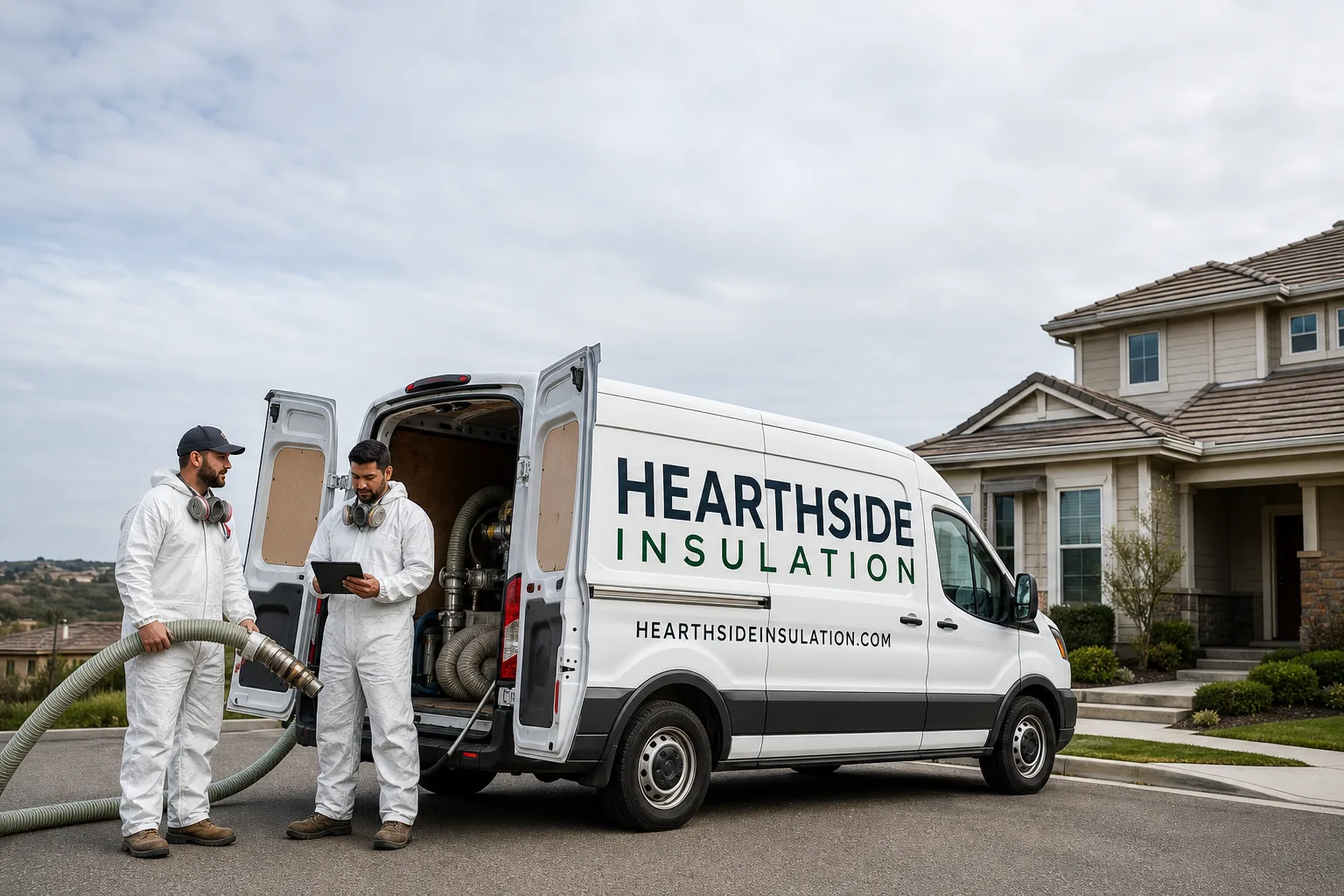
Fast, Reliable Spray Foam Insulation Across Pico Rivera
Spray foam insulation in Pico Rivera typically costs $2.50 to $6.50 per board foot installed, with most full attic retrofit jobs on 1950s-60s tract homes running between $4,800 and $11,000 depending on foam type and rafter bay depth. We’re usually working in Pico Rivera within 24 to 48 hours of your call. Hearthside Insulation has spent years on ladders in attics off Rosemead Boulevard, Washington Boulevard, and Whittier Boulevard, and we know exactly what those post-WWII stucco homes look like from the inside of a rafter bay. Call (877) 265-4871 and we’ll give you a straight answer on what your attic actually needs.
Here’s the short version. Pico Rivera homes were mostly built before central air. Attics here hit 135°F in July. The original R-11 fiberglass batts are long past their service life. And the fix that works in this city, on this housing stock, is spray foam applied to the underside of the roof rafters. Not because it’s trendy. Because it’s what these attics can physically accommodate without ripping out plaster ceilings.
Why Hearthside Insulation Is Pico Rivera’s Preferred Spray Foam Insulation Company
We’re a dedicated insulation contractor, not an HVAC crew running foam jobs on the side. That distinction matters more in Pico Rivera than almost anywhere else we work. This city has a very specific housing stock: single-story stucco tracts from the 1950s and 60s, wood-framed, low-pitch roofs, original plaster ceilings, and attic access through a small scuttle hole. When you call us about Spray Foam Insulation, the person who answers understands exactly what’s waiting up in that attic before we ever set foot on the property.
Trevor Bassett leads our crew, and his approach is simple: match the material to the application, not the other way around. We carry Icynene and Demilec spray foam systems, so we can give you an honest open-cell versus closed-cell comparison. Most single-line installers can’t do that. They sell what they stock. We stock both, plus Owens Corning, Johns Manville, Knauf, and Rockwool products for when foam isn’t the answer. In Pico Rivera, that material-agnostic position is the difference between a correct retrofit and an expensive mistake.
We work the full span of Pico Rivera’s ZIP codes, 90660, 90661, and 90662, from the riverbed neighborhoods to the hillside streets east of Passons. We know the lots are tight, the driveways are short, and your neighbors are close enough to hear our trailer beep. We respect that. Every job starts with a free attic assessment and an honest recommendation, even if that recommendation is “you don’t need foam here.”
Closed Cell Spray Foam Insulation in Pico Rivera
Closed Cell Spray Foam Insulation is the workhorse for Pico Rivera attics, especially on the low-pitch roofs that dominate the city’s 1950s-60s tracts. The product goes on as a liquid and expands to roughly 2 inches per pass, sealing rafter bays, blocking air movement, and adding structural rigidity to aging roof decks. In a city where attic temps routinely cross 130°F, closed-cell foam with an R-value around R-7 per inch makes a measurable difference in bedroom comfort the same summer it’s installed. Expect to pay $4.50 to $6.50 per board foot for closed-cell work in Pico Rivera, with a typical 1,000-square-foot attic running $7,000 to $11,000 using Icynene or Demilec closed-cell systems.
Why Closed-Cell Fits Pico Rivera’s Roof Lines
Pico Rivera’s post-war tract homes were built with shallow roof pitches and minimal rafter depth, usually 2×6. That physical constraint matters. Open-cell foam needs more inches to hit the same R-value. Closed-cell gets more thermal resistance into less depth, and it acts as a vapor barrier, which helps when warm attic air meets a cool interior ceiling plane. On the original composition shingle roofs common along streets like Lindsey Avenue and San Gabriel Boulevard, that condensation control extends the life of both the foam and the roof deck.
What a Closed-Cell Retrofit Involves Here
On a typical Pico Rivera attic, we’re not spraying the attic floor. We’re working from the scuttle hole, navigating around original framing, and spraying the underside of the roof sheathing between rafters. That means clearing away degraded fiberglass first, checking for knob-and-tube wiring, and air-sealing before foam goes on. This is the work that makes the difference between a foam job that performs and one that just looks covered. It is also the work that separates an insulation specialist from a generalist.
Open Cell Spray Foam in Pico Rivera
Open Cell Spray Foam is the lighter, more flexible option, expanding to fill rafter bays and wall cavities with a soft, spongy cell structure. In Pico Rivera it’s most often specified for interior wall cavities, garage ceiling applications, and rim joist sealing where sound attenuation matters as much as thermal performance. The material runs $2.50 to $3.50 per board foot installed, so a typical 1,000-square-foot Pico Rivera attic retrofit using open-cell runs $4,800 to $7,200. Using Icynene or Demilec open-cell products gives us two manufacturer options depending on the specific application and the homeowner’s budget.
Garage and Rim Joist Work in Pico Rivera’s Tight Lots
Pico Rivera lots are compact, and garages are usually attached or immediately adjacent to the living space. That makes garage ceiling spray foam one of the highest-leverage upgrades we do in this city. Most original tract homes here have uninsulated garage ceilings, meaning the garage bakes in afternoon sun and dumps heat into whatever sits above or beside it. Foam on the garage ceiling flips that dynamic. Rim joist spray foam matters here too, especially on homes near the Rio Hondo, where crawlspace air moves through the foundation and up into the wall cavities.
Open-Cell Where It Makes Sense Near the River Beds
Homes east of the 605 freeway and north of Telegraph Road often sit on former agricultural land, and that soil history shows up in how those homes settle. Open-cell foam’s flexibility makes it a smart choice for wall cavities in those structures, since it can accommodate slight movement without cracking or separating the way rigid materials sometimes do. It’s also the right call for interior wall sound control, which matters when your neighbor’s house is twelve feet from your bedroom window and the Whittier Boulevard traffic never really stops.
Trusted Brands We Service in Pico Rivera
Hearthside Insulation is authorized to install products from Owens Corning, Johns Manville, Knauf, and Rockwool alongside our spray foam systems from Icynene and Demilec. Eight brands. Three methods. One specialist. For Pico Rivera homeowners, that means we’re not pushing a single product line because it’s what we happen to stock. We’re matching the material to your roof pitch, rafter depth, wiring situation, and budget. If closed-cell foam is overkill for your garage and Rockwool batts do the job better for less money, we’ll tell you that. If your river-adjacent home needs open-cell flexibility, we’ll tell you that instead. That’s the whole point of being material-agnostic.
Common Spray Foam Insulation Problems We See in Pico Rivera Homes
- Foam sprayed over settled blown-in insulation near the river beds. Homes off Rivera Road and along the San Gabriel River often have legacy blown-in fiberglass that has drifted and settled unevenly on former agricultural soil. If foam goes over that without leveling or removal first, the hot spots over living areas persist under a seemingly insulated roof. We’ve seen this exact failure too many times to count.
- Closed-cell foam sprayed directly against knob-and-tube wiring. Many original 1950s-60s Pico Rivera attics still have active knob-and-tube conductors running through rafter bays. Encasing those conductors in closed-cell foam traps heat against aged insulation and creates a fire hazard. The wiring has to be assessed and addressed before foam touches it. We flag this on every single Pico Rivera attic inspection.
- Rafter-underside foam in unvented attics without a heat plan. A low-pitch Pico Rivera attic with minimal ventilation already sits at 130°F+ in summer. Applying foam to the rafter undersides without addressing ridge heat and off-gassing expectations leads to odor complaints and adhesion failures on original dusty plaster and bare wood. Proper prep and product selection prevent this.
- Foam over degraded R-11 batts left in place. The original R-11 fiberglass in these tract homes is almost always collapsed, mouse-soiled, and full of decades of dust. Foaming over it without removal makes a mess and reduces the foam’s contact with the sheathing. In Pico Rivera we pull the old material first. Always.
Pricing for Spray Foam Insulation in Pico Rivera, CA
A closed-cell rafter retrofit on a 1,000-square-foot Pico Rivera attic runs $7,000 to $11,000. Open-cell on the same footprint runs $4,800 to $7,200. Garage ceiling spray foam starts around $1,800 for a typical 400-square-foot garage. Rim joist sealing runs $1,200 to $2,800 depending on access and total linear feet. What moves the price? Attic access size, rafter bay depth, whether knob-and-tube wiring is present, how much old material needs removal, and whether you’re near the river with settled insulation that needs leveling. We quote everything after a free on-site assessment, and the price we give you is the price you pay. Call (877) 265-4871 to schedule yours.
We Also Serve Cities Near Pico Rivera
Hearthside Insulation runs crews into Pico Rivera from our Foothill Ranch base every week, and we extend the same material-agnostic approach to nearby homeowners in West Whittier-Los Nietos, Santa Fe Springs, Downey, and Whittier. Same team. Same brands. Same straight answers about what your attic actually needs.
Serving Pico Rivera, CA — Our Local Coverage Area
We’re based in the Pico Rivera area and know this community well. Use the map below to see our service coverage — if you’re nearby, we can almost certainly help.
FAQs About Spray Foam Insulation in Pico Rivera
Yes, you can spray foam under the rafters without touching your original plaster ceilings, and in most Pico Rivera tract homes that’s exactly what we do. The foam goes on the underside of the roof sheathing, not on the ceiling plane, so the plaster stays undisturbed. Call (877) 265-4871 and we’ll confirm what your specific attic layout allows.
Yes, spray foam fixes that hot spot permanently, but only if the settled material is removed or leveled before the foam goes on. We’ve worked on Pico Rivera homes near the Rio Hondo and San Gabriel where the legacy blown-in had drifted off-center and left the living room ridge hitting 135°F. Foam bridges those gaps once the old material is handled properly.
If closed-cell foam is sprayed directly against active knob-and-tube wiring, it traps heat against aged conductors and creates a dangerous fire hazard. We will not do it. In Pico Rivera we check every rafter bay for knob-and-tube before foam goes on, and if we find it, the wiring gets assessed and addressed first.
Closed-cell foam is generally the better choice for an unvented Pico Rivera attic hitting 130°F, because it delivers more R-value per inch and acts as a vapor barrier, which matters in high-heat, shallow-pitch rooflines. Open-cell can work, but it needs more depth to hit the same thermal performance. We’ll give you the honest comparison on-site.
You can insulate first, and in Pico Rivera’s 1950s-60s homes it’s usually the smarter move. Most of these tract homes never had central air, and foam insulation under the rafters makes the house dramatically more comfortable even with window units or a wall-mounted mini-split. Insulate first. Then reevaluate your cooling needs.
Ready to get your Pico Rivera attic sorted? Call (877) 265-4871 for a free estimate. Trevor Bassett and the Hearthside Insulation team will come out, get into the attic, and tell you exactly what it needs, no pressure and no product pushing.
Written by Trevor Bassett, Owner at Hearthside Insulation, serving Pico Rivera and the surrounding Whittier-area communities.