
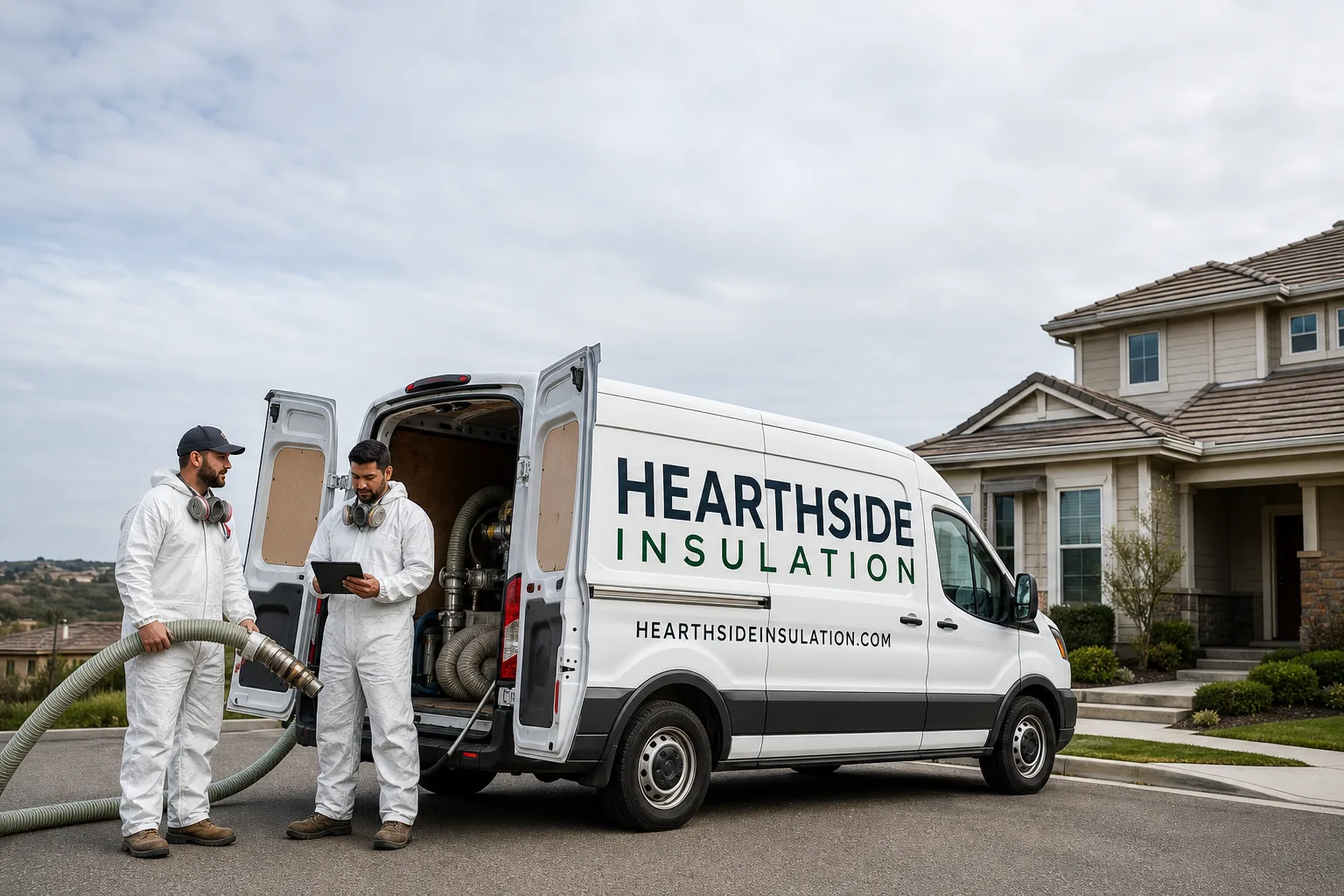
Fast, Reliable Spray Foam Insulation Across Upland
Spray foam insulation in Upland typically costs $2,800 – $6,400 for a full attic application, with closed cell running $2.10 – $3.80 per board foot and open cell at $0.90 – $1.80 per board foot installed. Most Upland jobs are completed in one day, and our crews from Foothill Ranch reach most Upland neighborhoods within 45 – 60 minutes. If you’re dealing with a 150°F attic in July or wind-driven dust from a Santa Ana event, call (877) 265-4871 and we’ll schedule a free estimate this week.
Hearthside Insulation works throughout Upland’s three ZIP codes, 91784, 91785, and 91786, from the flatland tract homes near Foothill Boulevard up to the foothill-edge developments off the 210. We know these attics because we’ve been inside hundreds of them. The framing, the sheathing condition, the venting patterns, the way a 1960s ranch house responds to summer heat versus a 2005 foothill build: these aren’t variables we guess at.
Why Hearthside Insulation Is Upland’s Preferred Spray Foam Insulation Company
Upland homeowners call us because we’re the insulation specialist, not a general contractor adding foam to a bid. Trevor Bassett built Hearthside around a simple idea: match the material to the house, not to what’s sitting in the warehouse. That’s why we carry both Icynene and Demilec spray foam systems, giving us honest open cell versus closed cell comparisons that single-line installers can’t offer. When a homeowner on the 91784 foothill edge asks whether closed cell is worth the premium, we can tell them exactly what each product does at 150°F attic temps and why one makes more sense for their roof deck than the other.
Our Upland customers regularly tell us the same thing: the estimate was more detailed than they expected and the install was cleaner. We’re an insulation-only contractor, which means our entire technical focus is thermal performance and air sealing. Trevor Bassett has kept Hearthside deliberately narrow, specializing in attic insulation, Spray Foam Insulation, and blown-in, because that focus is what lets us stock Rockwool for fire-conscious foothill clients, keep both Icynene and Demilec on the truck, and never push a product because it’s the only one we sell.
Closed Cell Spray Foam Insulation in Upland
Closed Cell Spray Foam Insulation is the right call for Upland homes when the roof deck itself needs an air barrier and moisture stop, not just more R-value. In the 91786 and 91784 tracts, where summer attic temperatures pass 150°F and Santa Ana winds push dust and embers into attic voids, closed cell gives you something open cell can’t: it bonds to cleaned sheathing and won’t absorb moisture, so it stays put when the assembly flexes through 70-degree temperature swings. A typical closed cell attic application in Upland runs $3,200 – $6,400 depending on square footage and rafter depth.
Roof Deck and Rafter Bay Application
We spray closed cell directly to the underside of the roof deck, converting the attic from a vented, baking-hot space into a sealed, conditioned zone. That matters in Upland because it stops radiant heat from entering the home’s living space through the ceiling plane. It also keeps wind-driven ash and dust out of the attic, which we’ll get into below.
Ember-Resistant Assemblies
Foothill-edge homes off the 210 in Upland get hit with ember and dust intrusion during Santa Ana events that inland neighborhoods never see. Closed cell’s density and adhesion give you a sealed assembly that rejects that airborne material rather than catching it in the batts. Homeowners in the 91784 tract with steeper roof pitches and larger attic footprints see the biggest benefit, because there’s more deck area to seal.
Open Cell Spray Foam in Upland
Open Cell Spray Foam is the value-forward option for Upland homeowners who want a full air seal without the cost of closed cell. It runs $0.90 – $1.80 per board foot installed, so a typical 1,200-square-foot attic in Upland lands between $2,800 and $4,600. We recommend it most often for flatland tract homes in 91785 and 91786 where the attic isn’t doubling as a moisture battleground and the homeowner’s priority is AC-driven cooling load reduction.
Air Sealing for AC Performance
Upland’s cooling load dominates the energy bill, and open cell’s air-sealing properties are what make it shine here. It fills cracks, gaps, and rim joist openings in minutes and expands to 100 times its liquid volume, so the air that would otherwise leak through the ceiling plane in a 1960s ranch home stays in the conditioned space. That translates to shorter AC runtime and fewer hot spots in rooms that used to bake by 4 p.m.
Rim Joist and Garage Ceiling Application
We see plenty of Upland garages with unconditioned ceiling cavities that bleed heat into the room above. Open cell is an efficient fix for rim joist bays and garage ceiling undersides, and it’s often paired with a roof deck application. Homeowners off Foothill Boulevard and Euclid Avenue ask about garage ceiling foam regularly, and the answer is usually yes, it’s worth doing at the same time as the attic.
Trusted Brands We Service in Upland
Hearthside is authorized to install insulation products from eight manufacturers, including Johns Manville, Knauf, and CertainTeed. On the spray foam side specifically, we run both Icynene and Demilec systems. That dual access matters in Upland because closed cell versus open cell isn’t a debate we settle with marketing language: it’s a technical call we can make cleanly because we carry both product lines and install them weekly. We keep local inventory staged for Upland jobs, including the specific foams we’ll need for foothill-edge assemblies, so we’re not waiting on a distributor when your install day comes.
Common Spray Foam Insulation Problems We See in Upland Homes
- Foam delamination over dust-fouled sheathing. After Santa Ana events, fine dust and ember residue settle on attic sheathing in foothill-edge homes. Foam sprayed over that layer adheres poorly and peels off in sheets. We clean and seal the substrate first, every time.
- Trapped heat under unvented closed cell applications. Attics in 91786 and 91784 hit 150°F regularly in July and August. If the assembly isn’t evaluated for ventilation first, closed cell traps that heat against the deck and stresses the foam. We verify venting or design a sealed assembly correctly before spraying.
- Unvented soffits on mid-century homes. Many 1950s – 1970s Upland tract houses have soffits that were never vented properly. When foam covers those cavities without makeup air, moisture and off-gassing issues follow. We address the soffit penetrations during the job, not after a problem appears.
- Sagging original batts under high heat load. We’ll touch on this in the vignette below, but the short version is that thin fiberglass batts from the original build fail structurally after decades of 150°F cycles. Foam is a replacement, not a top-up, and we treat it that way.
Pricing for Spray Foam Insulation in Upland, CA
Here’s what Upland homeowners can expect to pay. Closed cell foam runs $2.10 – $3.80 per board foot installed, which puts a typical full attic at $3,200 – $6,400. Open cell runs $0.90 – $1.80 per board foot, landing a standard attic at $2,800 – $4,600. Garage ceiling and rim joist applications are smaller jobs, usually $900 – $2,200 depending on square footage. What drives cost: the size of the attic footprint, rafter depth, how much prep the sheathing needs, and whether we’re also sealing soffit penetrations. Every estimate is free, and Trevor Bassett’s team gives you a line-item breakdown before you sign anything. Call (877) 265-4871 to get exact numbers for your house.
We Also Serve Cities Near Upland
Our crews work across the Inland Empire foothills, including Upland and the surrounding communities of San Antonio Heights, Claremont, Montclair, and Rancho Cucamonga. If you’re in one of those cities and want the same insulation-focused approach with eight brands and three methods, we’re already working nearby. Response times to those areas are comparable to what we offer Upland residents.
Serving Upland, CA — Our Local Coverage Area
We’re based in the Upland area and know this community well. Use the map below to see our service coverage — if you’re nearby, we can almost certainly help.
FAQs About Spray Foam Insulation in Upland
Because batts don’t stop Santa Ana-driven dust and embers from entering your attic, and they don’t seal air leaks that drive your AC bill. Spray foam bonds to the sheathing and creates a continuous air barrier, which means the heat, dust, and embers stay outside the conditioned space. Call (877) 265-4871 for a free evaluation of what your specific foothill-edge attic needs.
Yes, we can, but only after addressing the soffit penetrations. Foaming over unvented soffits on mid-century Upland homes traps moisture and creates off-gassing problems. We seal and prep those cavities before spraying, and we’ll flag it during the estimate so you know exactly what the job includes. Call (877) 265-4871 and ask about soffit prep.
It does. The 150°F-plus attic temperatures we see in Upland’s 91786 and 91784 tracts push us toward closed cell for roof deck applications because it tolerates those cycles better and won’t absorb moisture when the assembly flexes. Open cell still works in many Upland homes, but the heat load is part of the decision. We’ll walk you through the tradeoff on the estimate call.
We vacuum the deck, seal any loose or damaged sheathing, and ensure the substrate is clean enough for foam to bond properly. On a 1960s ranch off the 210 foothill edge in the 91784 tract, our crew found original thin fiberglass batts sagging off the roof deck and a layer of wind-driven dust and ember residue baked onto the sheathing. We vacuumed and sealed the deck before installing closed cell spray foam across the rafter bays, then foamed the garage-side wall and soffit penetrations so future Santa Ana events can’t drive ash into the attic. The homeowner got a tight, ember-resistant assembly instead of another layer of blown-in fiberglass over degraded batts. That’s the standard for every Upland job, not a special case.
Yes, and dramatically. Original rock-wool or thin fiberglass batts from the 1950s – 1970s in Upland homes lose most of their performance after decades of 150°F heat cycles. Replacing them with spray foam cuts the cooling load sharply because the air barrier stops conditioned air from leaking into the attic. Call (877) 265-4871 for a free estimate and we’ll tell you exactly what your attic is losing right now.
Homes on Upland’s foothill edge off the 210 don’t just bake in summer: wind-driven Santa Ana events pull fine dust and embers into attic and garage voids, so spray foam work here has to bond to a cleaned, sealed substrate rather than trap grit and ash against framing. That’s the difference between a foam job that lasts and one that delaminates in sheets two years later. Hearthside Insulation handles Upland’s specific conditions with the right prep, the right product, and crews who’ve done it hundreds of times. Call (877) 265-4871 for a free estimate.
Written by Trevor Bassett, Owner at Hearthside Insulation, serving Upland since the company’s founding from Foothill Ranch, CA.