
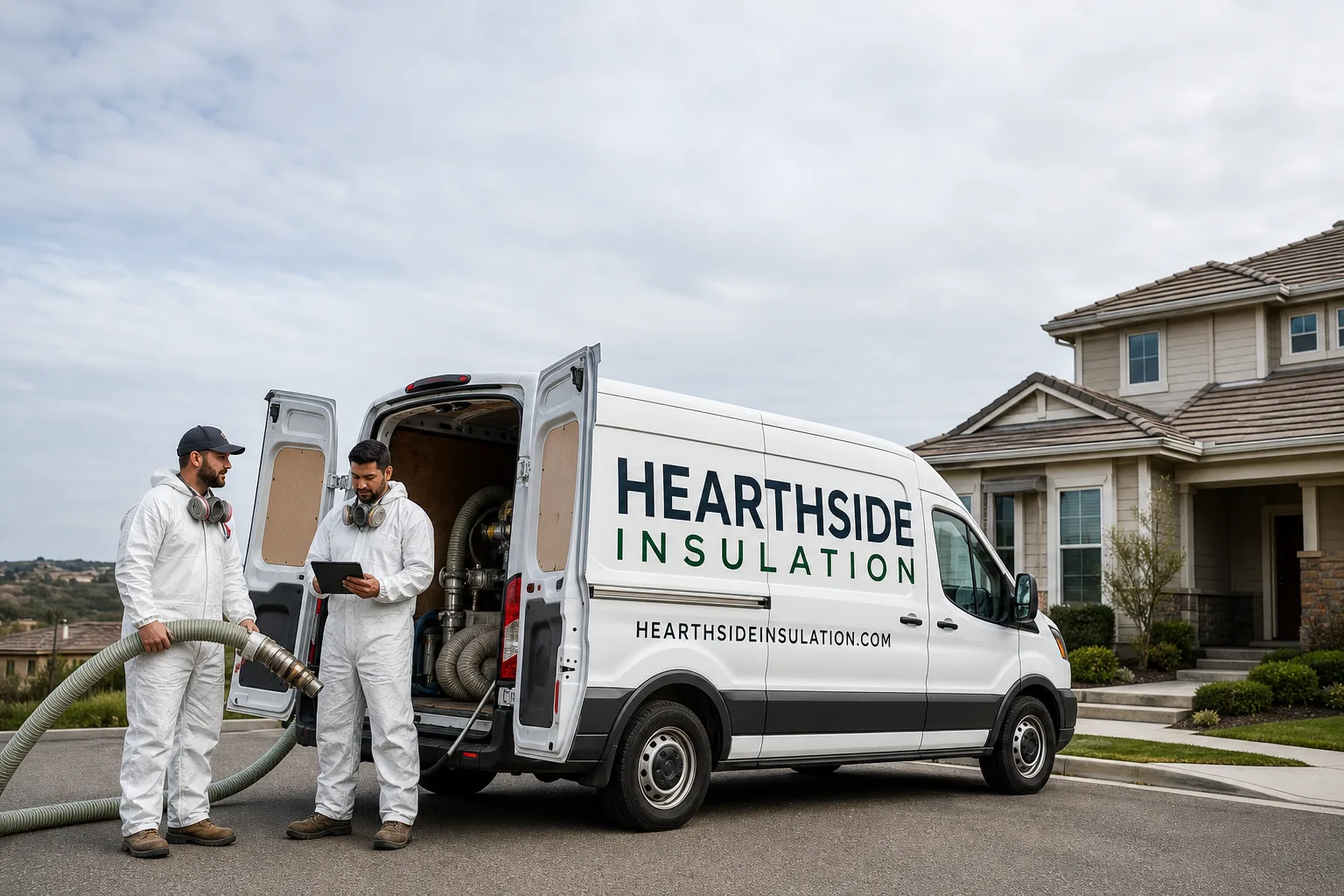
Fast, Reliable Attic Insulation Across Anaheim
Attic insulation in Anaheim costs between $1,800 and $4,600 for a typical 1,200 – 1,800 sq ft home, and most jobs are completed in a single day. If you live in a 1950s – 1970s tract home in the flat western ZIPs, there’s a good chance your original insulation has failed quietly over 60+ summers of Santa Ana heat. Hearthside Insulation has spent years working in attics from the Lincoln Avenue corridor to Anaheim Hills, and we know exactly what failure looks like in this city’s housing stock. Call (877) 265-4871 and we’ll give you a straight answer about what your attic actually needs.
Why Hearthside Insulation Is Anaheim’s Preferred Attic Insulation Company
We’re not a general contractor squeezing insulation between roofing jobs. Insulation is all we do. That focus means our crew can tell you, within minutes of looking at your attic, whether you need a top-up, a full removal, or something in between. Trevor Bassett built Hearthside around a simple idea: match the material to the home, not the other way around. Anaheim homeowners call us because we carry eight brands across fiberglass, mineral wool, spray foam, and cellulose: Owens Corning, Johns Manville, Knauf, Rockwool, CertainTeed, Icynene, Demilec, and GreenFiber. That breadth lets us recommend what actually fits your attic, your budget, and your cooling bill.
Response time to most Anaheim ZIPs runs 24 – 48 hours for estimates, and emergency calls in the flatlands and hills get priority scheduling. Our Attic Insulation team has worked in over 400 attics across Orange County, and a good number of those are right here in Anaheim. When you call, you talk to someone who knows what a collapsed R-7 batt looks like over a rear bedroom addition off Euclid Street.
Attic Mold Removal in Anaheim
Attic mold removal in Anaheim is a job we handle most often in the flat western ZIPs, where low-pitch roofs and poor original ventilation trap humid air against the roof deck. Anaheim’s late-summer heat plus the marine layer’s overnight condensation creates exactly the conditions mold loves. The process involves removing contaminated insulation, treating the affected framing with antimicrobial agents, correcting the ventilation problem, and reinstalling fresh material. In Anaheim, attic mold removal typically runs $2,800 – $5,500 depending on square footage and how far the mold has spread into the sheathing.
How We Remove Mold Without Spreading Spores
We set up negative-air containment before disturbing any contaminated material. The moldy insulation comes out bagged, the framing gets treated, and we never blow new insulation over active mold. That’s a shortcut some crews take in Anaheim’s hot attics to save time, and it always comes back.
When Mold Removal Needs Insulation Replacement
If the mold has penetrated the fiberglass batting or cellulose, the insulation itself has to go. Mold doesn’t just sit on top of insulation; it grows through it. In Anaheim’s older tract homes, we often find that the original insulation was under-vented from day one, which means the mold problem is structural to the attic’s airflow, not a surface issue. The fix is removal, air-sealing, and re-insulating to current code.
Attic Insulation Removal in Anaheim
Attic insulation removal in Anaheim is the single most common service we perform in homes built before 1980. The original R-7 fiberglass batts installed in mid-century tract homes off the 91 and Lincoln Avenue corridors have typically compressed, disintegrated, or been contaminated by rodent activity and decades of dust. Removal lets us start clean: air-seal the top plate, inspect wiring and can lights, and install material that actually performs. Expect to pay $1,200 – $2,800 for removal alone in an average Anaheim attic, with full replacement bringing the total to $3,500 – $6,200.
Why Top-Ups Don’t Work on Collapsed Batts
Blowing new insulation over collapsed batts is like putting a new roof over rotten decking. In Anaheim, where attic temperatures routinely exceed 150°F in late summer, degraded original insulation has already left the top plate exposed for years. A top-up buries the problem without fixing it. We remove, air-seal, and then install so the new material performs from day one.
Dealing With Old Vermiculite and Rodent Damage
Some Anaheim homes built before 1970 still have vermiculite insulation, which can contain asbestos and should never be disturbed without professional handling. We test before we touch it. Rodent-damaged insulation in the older tract neighborhoods is also common; we bag and remove it, sanitize the attic floor, and seal entry points before installing fresh material.
Trusted Brands We Service in Anaheim
We install and service insulation from Johns Manville, Knauf, Rockwool, and CertainTeed, among others, and we keep common material on hand for fast Anaheim turnaround. If you have a warranty claim on CertainTeed fiberglass or Rockwool mineral wool, we can handle the service work. We stock blown-in fiberglass, cellulose, and mineral wool batts locally, which means a mid-summer replacement in Anaheim doesn’t wait on a distributor’s truck.
Common Attic Insulation Problems We See in Anaheim Homes
- Collapsed original R-7 batts in 1950s – 1970s tract homes. The low-pitch attics common to Anaheim’s flat western ZIPs trap heat against the roof deck, cooking fiberglass until it flattens and loses its R-value. We routinely find attics where the top plate is completely exposed and the homeowner has been paying 30 – 40% more on cooling costs for years.
- Zero insulation over garage and rear bedroom additions. Many Anaheim additions were permitted without insulation requirements or built before code catches up. The roof deck over these spaces transfers heat directly into living areas. We see this constantly in homes from the 1950s through the 1980s.
- Missing or blocked attic baffles. In Anaheim’s older homes, original soffit vents are frequently painted over or buried under decades of insulation. Without baffles, airflow stalls, attic temperatures climb, and mold risk rises. We add or replace baffles as part of every insulation job where ventilation is deficient.
- Ember-intrusion gaps in Anaheim Hills. Homes in 92807 and 92808 with exposed rafter cavities and old vent assemblies can pull wind-driven embers into the attic during Santa Ana fire events. Standard fiberglass batts don’t address this. The fix requires ember-resistant vent screens, gap sealing, and material choices matched to the fire zone.
Pricing for Attic Insulation in Anaheim, CA
A straightforward blown-in attic insulation top-up in Anaheim runs $1,800 – $2,800 for a typical 1,200 sq ft attic reaching R-38. Full removal and replacement ranges $3,500 – $6,200 depending on attic accessibility, contamination, and material choice. Attic mold removal runs $2,800 – $5,500. Attic batt insulation for new construction or additions runs $1.20 – $2.50 per square foot installed. Anaheim Hills homes with vaulted ceilings and fire-zone requirements tend toward the higher end because of the additional air-sealing and ember-resistant vent work. Call (877) 265-4871 and we’ll give you a firm quote, not a vague range.
We Also Serve Cities Near Anaheim
Our crews work throughout north Orange County, including Fullerton, Placentia, Orange, and Villa Park. If you’re just outside Anaheim and need Attic Insulation in Anaheim-level expertise, we cover your area too. Same-day estimates are often available across all five cities.
Serving Anaheim, CA — Our Local Coverage Area
We’re based in the Anaheim area and know this community well. Use the map below to see our service coverage — if you’re nearby, we can almost certainly help.
FAQs About Attic Insulation in Anaheim
The original R-7 fiberglass batts in these mid-century tract homes have usually collapsed, compressed, or been contaminated after 50 – 70 years of heat cycling, and blowing new insulation over degraded material doesn’t restore performance. You need removal first. In Anaheim’s flat western ZIPs, we find original insulation that has disintegrated to dust in the hottest parts of the attic, especially over additions. Call (877) 265-4871 and we’ll inspect yours for free.
Homes in Anaheim Hills need ember-resistant vent assemblies, gap sealing at roof-to-wall transitions, and insulation materials chosen with fire performance in mind. Rockwool mineral wool is a strong choice here because it’s non-combustible and holds its shape in vaulted rafter cavities. Standard fiberglass batts alone don’t address the ember-intrusion vector that Santa Ana winds create.
Look for indoor rooms that won’t hold temperature in late summer, a ceiling that feels warm to the touch, rising cooling bills, and attic temperatures that feel like a sauna. In Anaheim’s low-pitch tract homes, failed insulation often shows up first in the rear bedroom and garage-adjacent rooms. If you see heat staining on the top plate or drywall, the insulation has been underperforming for years.
No, and any contractor who claims otherwise is cutting corners. Mold penetrates the insulation fibers; you can’t clean it in place. The contaminated material has to go, the framing gets treated, and fresh insulation goes in. In Anaheim’s humid late summers, this is the only approach that holds up. We’ll walk you through the whole process before any work starts.
For Anaheim’s resort-adjacent short-term rentals, we focus on two things: thermal performance for guest comfort and acoustic isolation between units and from the street. Rockwool mineral wool and dense-pack cellulose both offer sound attenuation that standard fiberglass doesn’t. These conversions also run on tight schedules between bookings, so we quote and schedule flexibly. Call (877) 265-4871 for a free estimate on your rental property.
Written by Trevor Bassett, Owner at Hearthside Insulation, serving Anaheim and north Orange County.