Fast, Reliable Attic Insulation Across Buena Park
Attic insulation in Buena Park typically runs $1,800 – $4,800 for a full retrofit on a mid-century tract home, with top-ups and radiant barrier jobs landing between $900 and $2,200. Most jobs we quote here are finished same-day or next-day because our crews know these exact houses: the 3-bed/2-bath stucco boxes off Beach Boulevard and Orangethorpe, the 1960s developments around Knott Avenue, the original townsite streets where attics still sit half-empty. If your ceiling feels warm in July or your AC won’t quit running, call (877) 265-4871 and we’ll walk the attic with you, not just hand you a number over the phone.
Why Hearthside Insulation Is Buena Park’s Preferred Attic Insulation Company
We work in this city so often that our crews can usually identify the original builder by the look of the attic. The 1948 – 1955 tract homes around the townsite near Beach and Stanton have a specific signature: shallow joist bays, original 1×6 roof decking, and duct runs that were installed before anyone in Orange County sealed a joint with anything better than cloth tape. Homeowners in 90620, 90621, 90622, and 90624 call us because we diagnose the whole thermal picture, not just the R-value: first the duct leaks, then the bare bays, then the radiant barrier. Trevor Bassett started Hearthside specifically because generalist contractors kept treating insulation as an add-on instead of the main event. That focus is what lets our crews finish a full Buena Park attic retrofit in a single day instead of stretching it across a week.
Radiant Barrier in Buena Park
Radiant barrier in Buena Park is one of the highest-yield upgrades you can make on a pre-Title 24 house, and we install it as a foil-faced material attached to the underside of the roof rafters, or as a foil-topped insulation batt laid over the joists. Buena Park sits inland of the coastal marine layer, so on a 90-degree July afternoon your attic can easily hit 140 degrees; a radiant barrier drops that surface temperature dramatically and cuts the heat that radiates straight down through your ceiling. A typical radiant barrier install over an existing attic runs $900 – $1,600 for a 1,100 – 1,500 square foot ranch. If your HVAC equipment sits in the attic, the payoff is even faster since the unit isn’t pulling 140-degree air through the return plenum.
Rafter-Mounted Foil for Maximum Heat Rejection
We staple the reflective foil to the rafter faces with an air gap below the roof deck. That gap is what makes it work: the foil re-radiates heat back toward the roof rather than conducting it into the attic. In Buena Park’s mid-century ranches with low roof slopes, this install is fast but physically awkward, and doing it wrong means knife-cuts in the foil that quietly kill its performance.
Foil-Faced Batt for Homes With Attic HVAC
When the furnace and duct runs sit in the attic, we often recommend a foil-faced fiberglass batt laid over the blown insulation instead. It’s less expensive than rafter-mounting, covers the joists themselves, and reflects radiant heat away from the equipment. We match the batt brand to the rest of the attic so you aren’t mixing incompatible materials, and we carry Owens Corning and CertainTeed products sized for the 16-inch and 24-inch on-center framing we see in Buena Park.
Attic Cleaning Services in Buena Park
Attic cleaning services in Buena Park mean more than hauling out old rat droppings: on most mid-century homes here, the real job is removing disintegrated flex duct, failed insulation, and rodent-nested batts before the new insulation goes in. The older neighborhoods carry a genuine salt-air effect, too. Buena Park sits close enough to the coast for that marine-influenced air to reach the attic, and on original galvanized duct hangers and fasteners, we see rust-through years before inland attics show the same thing. A full clean-out before an insulation retrofit on a 1,200 square foot home here typically runs $600 – $1,200, depending on the amount of debris and number of old ducts coming out.
Removal of Failed Ducts and Compressed Insulation
The collapse pattern we find on 1950s homes off Beach Boulevard is remarkably consistent: original galvanized trunk lines wrapped in disintegrating tape, flexible branch ducts reduced to bare spiral wire, and pink or yellow batts flattened to half their original loft by decades of heat and foot traffic from repairmen. We remove all of it by hand, bag it, and get the joist bays clean before anything new goes in.
Rodent Remediation and Sanitizing
Buena Park’s older homes are a magnet for roof rats and mice, especially near mature trees around the original townsite and along golf course edges. We remove nesting material, sanitize the affected areas, and seal the obvious entry points into the attic before new insulation goes down. Skipping this step means paying twice, because you don’t want a fresh layer of Owens Corning blown over an active rodent issue.
What happens when you call
- 1
A real person answersNo phone trees — you reach a local pro.
- 2
You get an upfront price rangeHonest numbers before anyone is dispatched.
- 3
A background-checked tech heads outLicensed & insured, dispatched right away.
- 4
You approve before work beginsNothing starts until you say go.
Trusted Brands We Service in Buena Park
Hearthside installs attic insulation from Owens Corning, Johns Manville, Knauf, and Rockwool, and we stock those products in the configurations our Buena Park jobs actually need: 16-inch and 24-inch batts, loose-fill for open blow or dense-pack, and mineral wool for homeowners who want fire resistance and acoustic deadening alongside the thermal gain. Since we aren’t tied to one manufacturer, the recommendation in your attic is driven by the house, not by what we happen to have on the truck. That matters in Buena Park because the older townsite homes, the 1960s tract ranches, and the newer 1970s two-stories each respond to a different material spec. You get the right fit, and nothing less.
Common Attic Insulation Problems We See in Buena Park Homes
- Bare joist bays with no insulation at all. The original townsite tract homes were built before California’s Title 24 energy rules, and many bays are still empty. Heat pours straight down through the ceiling in summer, and nothing in the attic slows it.
- Disintegrated flex duct bleeding conditioned air. The 1950s-60s duct runs in these homes were sealed with materials that fail badly over six decades. We routinely find branch ducts reduced to bare wire, with cooled air blowing into a 135-degree attic instead of into the bedroom.
- Salt-corrosion on metal attic hardware. The marine-influenced air that reaches Buena Park accelerates rust on duct hangers, fasteners, and the metal housing of attic-mounted furnaces. Hardware fails here years before the same parts rust inland.
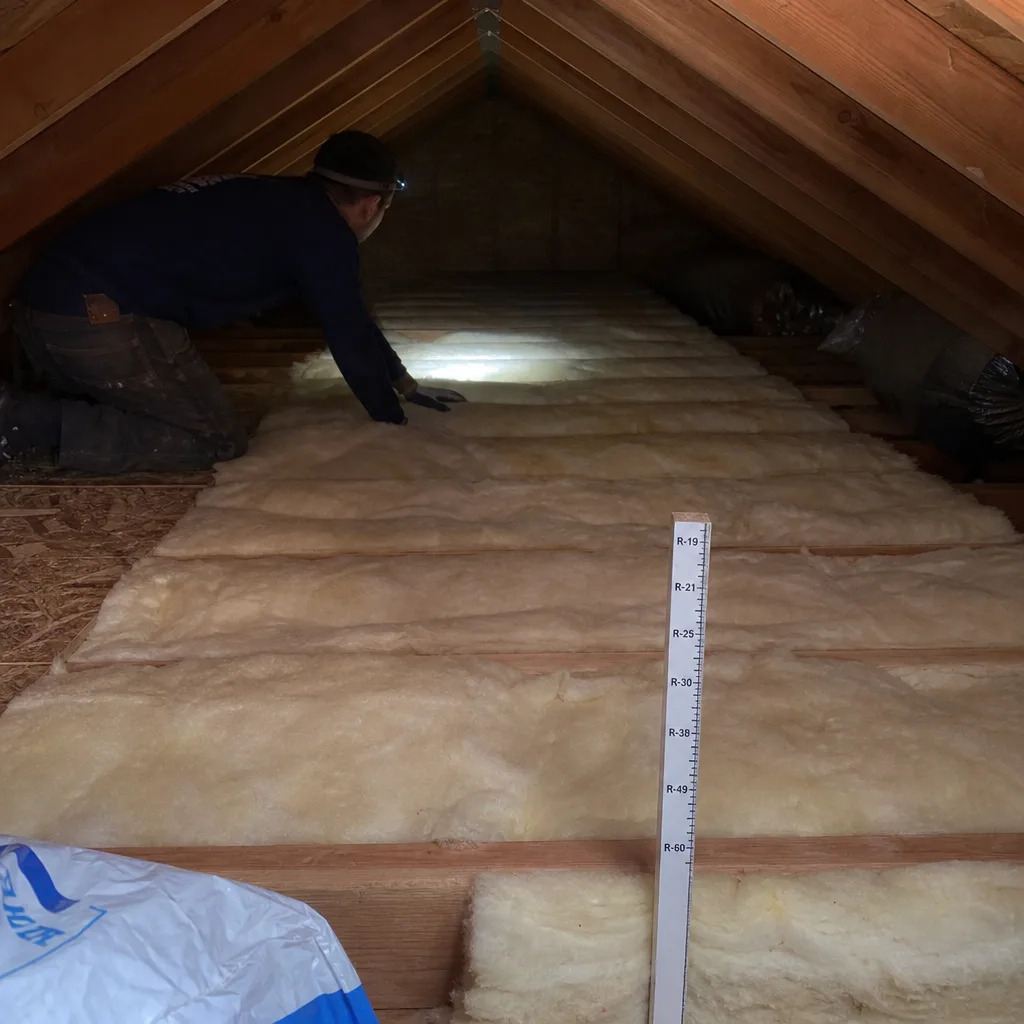
- Compressed fiberglass batts losing their effectiveness. Even where original insulation exists, decades of foot traffic and settled dust can flatten batts to a third of their designed loft. That’s a functional R-value closer to R-5 than the R-19 on the label.
Pricing for Attic Insulation in Buena Park, CA
Here are the numbers we actually quote in this city. Blown-in attic insulation to bring a 1,100 – 1,500 square foot Buena Park ranch up to current recommended levels runs $1,800 – $2,800. An attic insulation top-up runs $900 – $1,800 if your existing insulation is serviceable but thin. A full attic insulation replacement on a house with rodent damage or failed ducts runs $2,800 – $4,800, including removal. Radiant barrier adds $900 – $1,600, and attic cleaning before the insulation goes in adds $600 – $1,200. The biggest swing is whether we’re sealing and replacing the original duct runs, which most mid-century homes here need. Call (877) 265-4871 for a firm, took-the-measurements quote. Estimates are free.
We Also Serve Cities Near Buena Park
Hearthside insulation crews work across northern Orange County. If you’re in La Palma, Cypress, La Mirada, or Cerritos, you’re still inside our regular service area, and the housing stock is similar enough that the same patterns apply. To see how we approach attic insulation across the wider region, start with our Attic Insulation overview page. For a look at what’s unique about this specific city’s housing and climate, see Attic Insulation in Buena Park.
Serving Buena Park, CA — Our Local Coverage Area
We’re based in the Buena Park area and know this community well. Use the map below to see our service coverage — if you’re nearby, we can almost certainly help.
FAQs About Attic Insulation in Buena Park
Homes built in the late 1940s through the 1950s around Beach Boulevard and the original townsite went up before California’s Title 24 insulation requirements existed, so builders often skipped attic insulation entirely, and what little went in was thin and poorly secured. Over the decades, repair crews moved the original batts aside to access ceiling fixtures or ductwork and never put them back, leaving bare bays. The duct runs from that era were sealed with cloth tape and installed with flex sections that break down into bare wire. None of this is unusual for a Buena Park home of that vintage, and the fix is a full retrofit: remove the failed ducts, seal the plenum and boot joints with mastic, and blow in new insulation to current Code levels. Call (877) 265-4871 and we’ll show you exactly what’s in your bays before we quote anything.
Yes it does. Buena Park is far enough inland that you don’t get the heavy fog of Huntington Beach, but the marine-influenced air still reaches the city, especially in the older neighborhoods west of the 5. That salt-laden air sits on bare galvanized duct hangers, fasteners, and the sheet metal housing of attic furnaces, and it accelerates rust-through by years compared to what we see in inland Orange County. The clue is on the hardware itself: orange-brown rust bloom on hangers and screws, and duct straps that snap when you lift them. We account for this when we spec replacements, using corrosion-resistant fasteners and sealed duct connections so the new hardware isn’t rusting out in a decade.
For most mid-century Buena Park homes, do both, but do them in the right order. Insulation slows conductive and convective heat transfer; a radiant barrier reflects radiant heat back before it ever heats the insulation. On a 90-degree summer afternoon, your attic space climbs far above ambient because the roof deck is absorbing solar energy; that heat radiates down into the insulation below. A radiant barrier installed at the rafter level blocks that radiant path, and the insulation below it works less hard. If you only do one, a radiant barrier without adequate insulation leaves you cold in winter, and insulation alone still lets the attic bake and radiate heat downward. The combination is the highest-performance attic we build in this city.
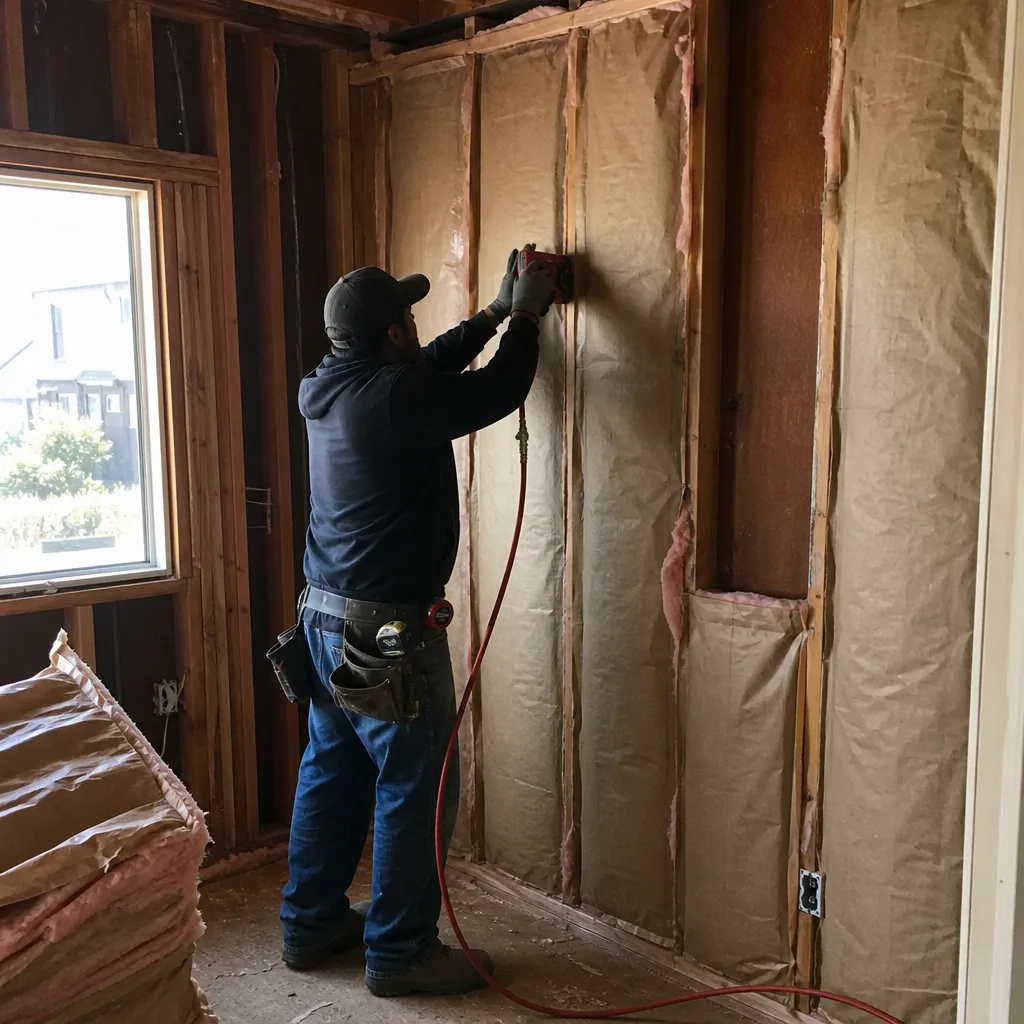
Blowing wall cavities in Buena Park’s 1940s-60s homes is the trickiest part of the job because the interior surface differs house to house: original lath-and-plaster in the early townsite homes, early drywall in the later 1950s tract houses, and multiple renovation layers in between. We don’t guess at the cavity depth or the sheathing condition. We open a small access at the top of each stud bay, inspect what’s actually inside, then dense-pack cellulose or injection foam only where the cavity is clean and dry. If the wall has original knob-and-tube wiring, which we still find in the oldest homes here, we don’t blow anything until a licensed electrician clears the circuit. Wall insulation matters less than attic insulation in Buena Park’s climate, but on a hot west-facing wall it makes a real comfort difference.
We install Owens Corning, Johns Manville, Knauf, and Rockwool products, and we match the material to the house and the goal rather than pushing one brand on every job. Loose-fill fiberglass from Owens Corning or Knauf is our workhorse for open-blow retrofits in standard tract homes. Johns Manville batts go into jobs with deep joist bays and new construction or addition work. Rockwool mineral wool is a frequent recommendation for homeowners near busy corridors like Beach Boulevard or the 5 who want acoustic deadening along with fire resistance, and it’s worth the premium if you sleep with the windows open. For spray foam applications we’re certified on both Icynene and Demilec systems, so the open-cell vs. closed-cell conversation is a real comparison, not a sales script. The right material is the one your attic actually needs.
Written by Trevor Bassett, Owner at Hearthside Insulation, serving Buena Park and northern Orange County.