
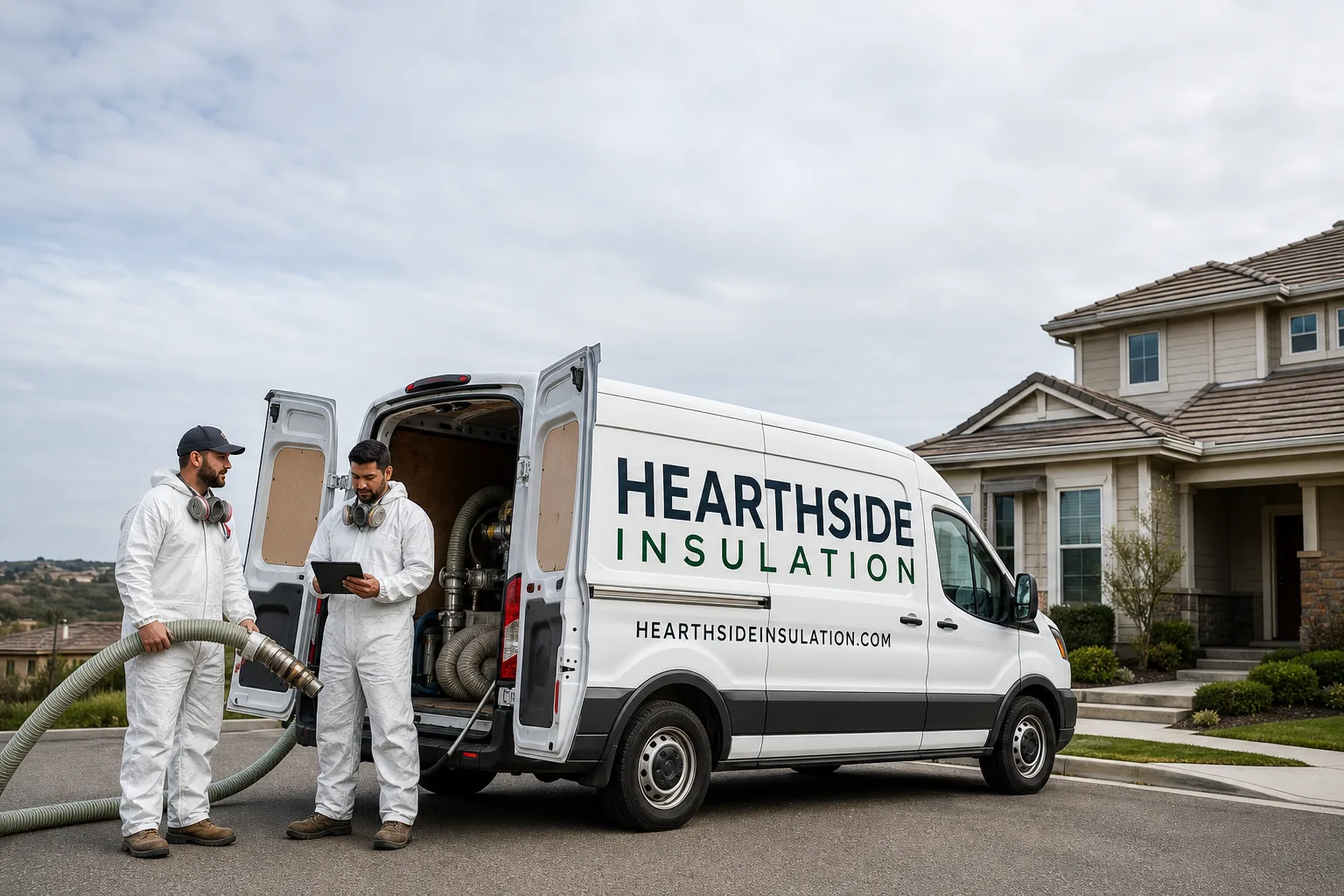
Fast, Reliable Spray Foam Insulation Across Lake Forest
Spray foam insulation in Lake Forest typically runs $2.50 to $6.50 per board foot installed, with most whole-attic retrofits on 1970s and 1980s tract homes landing between $4,800 and $9,200 depending on depth, roof pitch, and whether we’re pulling old batts. We get to Lake Forest quickly, usually within a day or two for estimates, because our Foothill Ranch shop sits right up Bake Parkway, less than ten minutes from most Lake Forest neighborhoods. If you’re fighting hot upstairs bedrooms in July, drafty walls in January, or utility bills that seem untethered from actual comfort, call (877) 265-4871. We know these houses, and we know exactly what’s happening in your attic.
Why Hearthside Insulation Is Lake Forest’s Preferred Spray Foam Insulation Company
Lake Forest isn’t a city of one-off custom builds. It’s master-planned tracts, repeating floor plans, and builder-grade insulation decisions made between 1969 and 1995. That repetition works in your favor when you hire a crew that’s insulated hundreds of these same homes. We can tell you what’s in your attic before we climb the ladder, because we’ve seen the R-11 batts in Ranchwood, the shallow joist bays off El Toro Road, and the vented low-pitch roofs throughout the Foothill Ranch side. Homeowners across 92630 call us because we name the actual problem, not just the product we want to sell.
Trevor Bassett leads a crew that installs spray foam from both Icynene and Demilec, which means your Lake Forest home gets the open-cell or closed-cell product that fits the application, not whichever system we happen to carry more of. We’re authorized across eight manufacturers, so when a rim joist in a stucco tract house needs something different than a vaulted ceiling, we match the material to the job. That’s the whole point of being an insulation specialist rather than a general contractor who squeezes in foam work between HVAC calls.
We also know Lake Forest’s building rhythms. Master-planned tracts mean predictable framing, predictable attic depths, and predictable failure points. A house off Muirlands Boulevard built in 1984 doesn’t surprise us the way it might surprise a crew from Anaheim or Riverside. We already know the soffit layout, the likely insulation depth, and where the air leaks are hiding.
Spray Foam Wall Insulation in Lake Forest
Spray Foam Wall Insulation in Lake Forest usually means retrofitting wood-framed stucco walls where original fiberglass batts have settled, compressed, or been chewed through by rodents over four decades. The job involves either injecting foam into existing wall cavities through small access holes or, when walls are open during a remodel, spraying directly onto the sheathing before drywall goes back. Lake Forest homeowners pursue this when rooms stay cold despite a running furnace, when one side of the house bakes in afternoon sun, or when they’re opening walls for a kitchen or bath renovation and don’t want to miss the air-sealing window. Expect wall cavity retrofits to run $3,000 to $7,500 for a typical single-story tract home, with full-wall spray during new construction or major remodel landing between $6 and $9 per square foot of wall area.
Open-Cell vs. Closed-Cell in Wood-Framed Walls
For Lake Forest’s stucco-over-wood-frame construction, open-cell foam from Icynene usually makes more sense inside wall cavities. It fills the irregular gaps left by old wiring, plumbing runs, and settling framing, and it won’t trap moisture against the sheathing the way a closed-cell barrier can in our dry-summer, damp-winter cycles. Closed-cell from Demilec earns its cost when you need structural rigidity or when a wall cavity is so shallow that open-cell at full depth still wouldn’t hit a useful R-value.
What Wall Retrofits Actually Feel Like
After a wall injection, homeowners notice the thermostat holds steady longer and rooms stop losing heat within an hour of the furnace cycling off. The draft that used to find your ankles on the sofa disappears, because foam seals the framing joints and electrical penetrations that fiberglass never could. That’s the difference between insulating and air-sealing, and it’s the part most retrofit bids skip.
Rim Joist Spray Foam in Lake Forest
Rim Joist Spray Foam in Lake Forest targets the band board where your first-floor walls meet the foundation, and in 1970s and 1980s tract homes, this seam is almost always uninsulated and leaking. The job involves clearing any old fiberglass stuffing or debris from each joist bay, then spraying closed-cell foam along the rim to stop air movement from the crawlspace or basement into the living space above. Lake Forest homeowners typically need this when floors stay cold in winter, when pests keep finding their way into the house from underneath, or when the crawlspace smells musty and the air inside never feels fresh. Retrofitting the rim joist on a typical two-story Lake Forest tract home runs $1,800 to $3,400, and we complete most jobs in a single day.
Why Closed-Cell on the Rim
Closed-cell foam is the right call here, and we recommend Demilec for most rim joist work. It acts as a vapor retarder, which matters when crawlspace moisture meets the wood framing. It also adds enough density to deter rodents, which is a real concern in the older Lake Forest tracts where field mice and roof rats have spent decades finding entry points. Open-cell on a rim joist absorbs that moisture and leaves the band board damp and vulnerable.
Pests, Drafts, and Utility Bills
The rim joist is the most overlooked air leak in Lake Forest houses. When it’s sealed, the stack effect that pulls crawlspace air up through wall cavities gets interrupted, which means fewer cold floors, less dust, and lower heating bills from November through February. The change is immediate the first evening after the foam cures.
Trusted Brands We Service in Lake Forest
We carry and install spray foam from Icynene and Demilec, two of the most widely specified manufacturers in the industry, and our broader material lineup includes Owens Corning, Johns Manville, Knauf, Rockwool, CertainTeed, and GreenFiber. For Lake Forest tract homes, that breadth matters in a specific way: a shallow 1970s joist bay needs a different product decision than a 1990s vaulted ceiling, and we don’t have to force an Icynene product into a Demilec application or vice versa. Our Foothill Ranch location keeps foam and fiberglass materials staged for fast turnaround across 92630, so a project scheduled on Tuesday doesn’t wait on a parts shipment from Riverside. We stock what these houses need, because these are the houses we insulate every week.
Common Spray Foam Insulation Problems We See in Lake Forest Homes
- Foam sprayed tight against the soffit on shallow joist bays. The 1970s El Toro Road tracts combined low-pitch roofs with just enough joist depth for R-11 or R-19 batts. When a crew sprays foam flush to the roofline without installing vent baffles first, the soffit air path closes off, attic heat climbs, and shingles wear years early. It’s a sequencing mistake we fix often.
- Air-sealing skipped before foam over settled batts. Original fiberglass in these attics has compressed to half its labeled depth, and it’s often been rearranged by rodents. Spraying foam over that without first pulling the batts and sealing the ceiling plane leaves the gaps open, and 130-plus-degree attic air keeps filtering into the house. The foam isn’t the failure; the skipped prep is.
- Builder-grade vented attics treated as closed assemblies. Some Lake Forest attics were designed to breathe, with soffit and ridge vents sized for a specific air path. Foaming them without intake baffling traps moisture against the decking in our damp winter months, defeating the cooling savings and inviting deck rot.
- One-size-fits-all open-cell on rim joists and crawlspace edges. Open-cell absorbs the crawlspace moisture that closed-cell blocks, leaving the band board damp and inviting pests. We see it on houses where a general contractor ran foam insulation as a side job without understanding the moisture profile of Lake Forest’s stucco-on-wood-framed construction.
Pricing for Spray Foam Insulation in Lake Forest, CA
For planning purposes, here’s what we see in Lake Forest: whole-attic retrofit on a 1,500-to-2,200-square-foot tract home runs $5,800 to $9,200 when we pull and dispose of old batts, air-seal the ceiling plane, install baffles, and spray to code-appropriate depth. Wall cavity injection runs $3,000 to $7,500 depending on wall count and floor plan, and rim joist sealing lands $1,800 to $3,400. Garage ceiling spray foam on an attached garage with living space above typically comes in at $1,400 to $2,600. The biggest variable isn’t square footage, it’s house age: 1970s homes with rodent-disturbed batts and shallow bays take more prep than a 1990s tract with deeper joists and cleaner framing. We don’t bid blind. Call (877) 265-4871 and Trevor Bassett can walk your specific floor plan and attic over the phone before we ever send someone out.
We Also Serve Cities Near Lake Forest
Our Foothill Ranch shop keeps us close to the whole Saddleback Valley. In addition to Lake Forest, we regularly run Spray Foam Insulation crews to Foothill Ranch, Portola Hills, Mission Viejo, and Laguna Woods. Same crews, same brands, same tract-era knowledge, just a few minutes further down the 241 or El Toro Road.
Serving Lake Forest, CA — Our Local Coverage Area
We’re based in the Lake Forest area and know this community well. Use the map below to see our service coverage — if you’re nearby, we can almost certainly help.
FAQs About Spray Foam Insulation in Lake Forest
Foam makes sense if the attic is air-sealed first and the soffit air path is preserved with vent baffles. In a shallow-bay 1970s attic, spraying directly over compressed, rodent-disturbed batts without prep traps heat and moisture and gives you the worst of both worlds. When we foam these attics, we pull the old batts, seal the ceiling plane, fit baffles in the shallow joist bays, and then spray Icynene open-cell or Demilec closed-cell depending on the roof pitch and venting. The result is a hybrid vented-and-sealed assembly that cuts cooling load without baking the deck. If you’d rather not pull the old material, blown-in fiberglass or GreenFiber cellulose over baffles is still a legitimate, lower-cost upgrade, but it won’t air-seal the ceiling plane the way foam does. Call (877) 265-4871 and we’ll tell you which path fits your attic, your budget, and your roof’s remaining life.
In almost all cases, no, but the honest answer depends on the builder and the specific warranty language. Most Lake Forest tract warranties cover structural and systems defects, not energy-efficiency retrofits, and adding insulation in an attic or wall cavity doesn’t trigger a void. The exceptions we’ve seen involve roofs where the builder’s roofer specified a certain ventilation profile, and foaming the deck would alter it. Before we quote foam on a newer Lake Forest home, we check the ventilation geometry and flag anything that might interact with a warranty claim. That caution is part of why we’re the insulation-only specialist rather than a general contractor guessing.
Because the attic above those rooms acts like an oven, and your ceiling insulation isn’t stopping the heat. Lake Forest attics routinely sit above 130 degrees in July and August. The original R-11 or R-19 batts on the attic floor have settled, compressed, and lost most of their labeled performance, which lets radiant heat push straight through the ceiling and into the upstairs bedrooms. Your AC is fighting a load it was never sized for. Foam, combined with air-sealing the ceiling plane, drops that attic-to-room heat transfer dramatically. We’ve had Lake Forest homeowners tell us their upstairs stopped spiking on July afternoons within a week of the retrofit.
Yes, and we do it regularly across Lake Forest. The rim joist is accessed from the crawlspace or basement side, through the floor framing, which means the stucco exterior never gets touched. We clear the joist bays, close off any pest entry points we find, and spray closed-cell Demilec along the band board. For a typical stucco-over-wood-frame tract house, the job takes a day and runs $1,800 to $3,400 depending on linear footage and how much old debris or rodent damage we have to clean out first.
Lake Forest’s housing stock repeats. Every neighborhood off El Toro Road, Trabuco Road, and Bake Parkway was built out in planned tracts between the late 1960s and the 1990s, with the same handful of builders running the same floor plans dozens of times. That means we can predict attic depth, soffit layout, and original insulation type by knowing the tract and era. Mission Viejo has more varied lot sizes and some newer custom work; Laguna Hills has more townhome stock; Lake Forest’s specific challenge is the 1970s shallow-bay, low-pitch roof over compressed R-11 batts. The foam decision and the baffle sequencing follow from that. A generic spray foam page can’t tell you that. We can, because we’ve opened enough of these attics to know what’s behind the access hatch before we climb up.
If you’re in Lake Forest and tired of hot upstairs rooms, nosebleed summer bills, or drafts that find you in December, call (877) 265-4871. We’ll send someone who knows your tract, knows your attic, and knows exactly which foam fits. Estimates are free, and we don’t upsell what your house doesn’t need.
Written by Trevor Bassett, Owner at Hearthside Insulation, serving Lake Forest and the Saddleback Valley from our Foothill Ranch shop.