
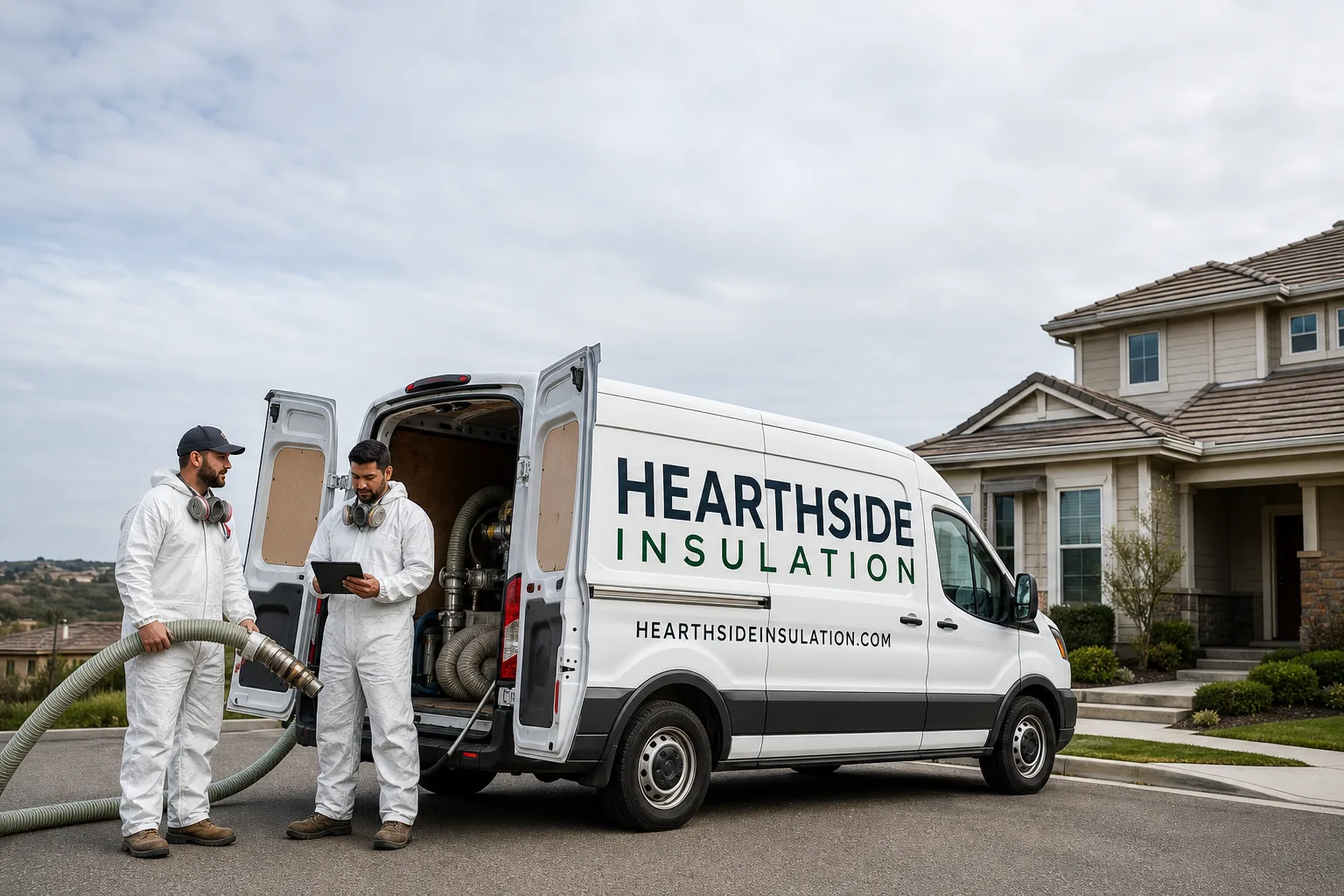
Fast, Reliable Spray Foam Insulation Across Villa Park
Spray foam insulation in Villa Park typically costs $2.75 to $6.50 per board foot for closed-cell and $0.90 to $2.10 for open-cell, with most whole-attic projects on the large custom homes here landing between $6,500 and $18,000 depending on roof complexity. Our crews reach most Villa Park jobs the same week, often within 48 hours for inspection. Call (877) 265-4871 and we’ll give you a straight answer on what your home actually needs, not a generic square-footage quote.
Villa Park isn’t a tract-home town. The houses off Serrano Avenue, along Lemon Street, and up near Santiago Boulevard sit on oversized lots with multi-wing footprints, vaulted ceilings, and attics that have been touched and retouched over decades of remodels. That changes how spray foam should be planned and applied. We know because we spend our weeks inside those attics, not running crews through uniform developments three cities away. This page covers what Villa Park homeowners should expect when considering spray foam insulation: how it works in this specific housing stock, what it should cost, and the failure modes we see far too often from contractors who treat every attic like a simple cavity.
Why Hearthside Insulation Is Villa Park’s Preferred Spray Foam Insulation Company
Hearthside Insulation isn’t an HVAC company that picked up insulation as a side line. We’re a dedicated insulation contractor, and in Villa Park that matters more than almost anywhere else in North Orange County. The attics here are irregular, multi-level, and often patched together from two or three separate construction phases. A generalist crew that runs hundreds of tract-home attics in Anaheim or Placentia simply doesn’t have the reps with this kind of assembly. We do.
Villa Park homeowners call us after other companies have walked the attic and come back with a one-line quote: so many board feet of foam, done. The problem is that a single R-value blanket quote is the surest sign a contractor hasn’t actually looked at the house. One multi-wing ranch off Serrano Avenue had three distinct ceiling assemblies under one roof: original 1960s framing, an 80s addition with different rafter spacing, and a 2010s remodel that had closed-cell Icynene in the wall cavities but nothing at the top plates. Three assemblies, three different air-sealing needs, one job. That’s what we mean when we say we match the material to the application, not the other way around.
We carry both Icynene and Demilec spray foam systems, which gives us honest open-cell versus closed-cell options for Villa Park’s specific demands. Most single-line installers can only sell you the one chemistry they stock. We’d rather tell you your west-facing vaulted ceiling needs closed-cell R-21 at the roof deck while an interior partition wall can take open-cell at half the material cost. Call (877) 265-4871 for a consultation that starts with your attic, not a price sheet.
Spray Foam Insulation Contractors in Villa Park
Spray Foam Insulation Contractors in Villa Park are working against a specific set of conditions: oversized, phased custom homes where attics were never designed as uniform thermal envelopes. A proper spray foam installation here starts with a per-assembly assessment: which sections of the house were built when, which connections are sealed and which are not, and where the thermal boundary actually sits in a multi-wing footprint. Then the material decision follows.
Most Villa Park spray foam projects run $3,200 to $9,500 for rim joist and crawlspace work, and $6,500 to $18,000 for full attic applications, with the bigger number reflecting cathedral and vaulted ceiling coverage rather than simple flat-attic layering. Closed-cell foam consistently lands at the higher end because it doubles as an air and vapor barrier, which matters in a roof assembly. Open-cell is cheaper per board foot but requires a separate vapor strategy in vented attics.
Open-Cell vs. Closed-Cell in Multi-Wing Homes
Open-cell foam is the right call for interior sound control and non-structural fill in vented attic spaces where moisture can still move. It costs less and carries an R-value around 3.7 per inch. In Villa Park homes with long hallways and separated bedroom wings, it also deadens the sound transfer between living spaces far better than fiberglass.
Closed-cell foam adds structural rigidity, rejects bulk water, and reaches R-6.5 to R-7 per inch. We specify it for the roof decks of cathedral ceilings, rim joists, and any assembly where Santa Ana wind-driven rain or radiant heat is the main opponent. The two chemistries aren’t interchangeable: choosing based on the assembly, not the bid, is what makes a Villa Park job hold up.
Spray Foam Attic Insulation in Villa Park
Spray Foam Attic Insulation in Villa Park is where this housing stock punishes careless work. These aren’t square, open attics above ranch boxes. They’re sprawling spaces with knee walls, soffited dormers, multiple gable intersections, and decades of accumulated loose fill that previous owners added piecemeal. That patchwork of old GreenFiber or fiberglass lying directly against the roof deck creates exactly the wrong base layer for spray foam: it prevents adhesion and leaves voids behind the foam.
A useful Villa Park attic project starts with removal or careful isolation of that old material, then air-sealing at the top plates and can light penetrations, then baffling any vented sections. Only then does foam get applied. Skipping the first two steps is how you end up with a vaulted ceiling that still bakes by 3 p.m. and a roof deck that’s slowly gathering moisture.
Removal and Air-Sealing Before Foam
When we encounter decades-old blown cellulose or fiberglass in a Villa Park attic that’s being converted to a sprayed assembly, the legacy material has to come out or be completely separated from the spray zone. Foam doesn’t stick to dust, and it can’t bridge around loose fill. We remove it, expose the structural connections, and seal them before spraying.
Air-sealing is the quiet half of the job. Spray foam does some of it inherently, but top plates, electrical penetrations, and gaps between original framing and later additions need direct treatment. In a phased Villa Park home, the seam between the 1970s original section and a 1990s addition is almost always the leakiest plane in the entire attic.
Cathedral and Vaulted Ceiling Applications
Cathedral ceilings with no attic cavity above them demand closed-cell foam at the rafter bays, and in Villa Park they also demand baffles or vent channels if the roof is ventilated. Spraying directly against the roof deck without a ventilation path traps moisture against the sheathing and shortens the roof’s life. We see this failure mode routinely in high-end remodels where the drywall crew framed the ceiling tight to the rafters and nobody thought through the assembly.
Trusted Brands We Service in Villa Park
We install Icynene and Demilec spray foam systems in Villa Park, and we service existing installations from Owens Corning, Johns Manville, and Knauf as part of broader insulation retrofits. Having access to eight manufacturer lines across fiberglass, mineral wool, spray foam, and cellulose means we’re never forcing a brand into an assembly it doesn’t fit. If your Villa Park home has an older Owens Corning fiberglass attic that needs selective foam air-sealing at the rim joists, we’ll tell you that rather than quoting a full tear-out. If Rockwool’s fire resistance makes more sense against a Santa Ana exposure on one wing, we’ll say that too. Material decisions follow the house, not our inventory.
Common Spray Foam Insulation Problems We See in Villa Park Homes
- Over-applied closed-cell in vaulted ceilings without baffles. Contractors spray the full rafter bay depth and call it done, but the roof deck now has no drying path. In Villa Park’s hot summers, trapped moisture pushes sheathing temperatures up and accelerates rot. This is the most expensive mistake we’re asked to correct.
- Treating a multi-wing attic as one uniform cavity. The original 1960s section and a 2005 addition don’t share the same framing, air pathways, or thermal boundary. A single R-value quote misses the seams entirely, and the house still leaks air through the connection points.
- Spraying over old loose fill and remodel debris. Decades of accumulated blown-in insulation, drywall dust, and construction scraps create a barrier between the foam and the structural surface. Adhesion fails, voids form, and the homeowner paid for an air seal that doesn’t exist.
- West-facing vaulted ceilings with open-cell where closed-cell belongs. Open-cell is a fine product, but it won’t stop the radiant heat load a west-facing Villa Park ceiling absorbs from 2 p.m. to 7 p.m. in August. Choosing the cheap board foot over the right assembly leaves the room hot and the AC running nonstop.
Pricing for Spray Foam Insulation in Villa Park, CA
Open-cell spray foam in Villa Park runs $0.90 to $2.10 per board foot installed. Closed-cell runs $2.75 to $6.50 per board foot. A full attic on a standard two-story Villa Park home typically lands between $6,500 and $12,000, with cathedral and vaulted ceiling work pushing that range toward $18,000 because of scaffold setup, baffling, and the slower close-cell application those assemblies require. Rim joist sealing alone is a smaller job: $1,400 to $3,200 depending on how many foundation sections the house has. A partial project, like air-sealing one addition or treating a single garage ceiling, often falls between $2,500 and $5,500. Call (877) 265-4871 and we’ll walk your specific attic with you and price it honestly before any work begins.
We Also Serve Cities Near Villa Park
Our crews work throughout the North Orange County foothills and flatlands surrounding Villa Park, including Spray Foam Insulation in Villa Park‘s neighboring communities of Orange, North Tustin, Placentia, and Anaheim. The housing stock shifts quickly in this area, from Villa Park’s custom lots to the tighter tract homes nearer the 55.
Serving Villa Park, CA — Our Local Coverage Area
We’re based in the Villa Park area and know this community well. Use the map below to see our service coverage — if you’re nearby, we can almost certainly help.
FAQs About Spray Foam Insulation in Villa Park
Yes, and in most Villa Park homes with true cathedral ceilings, closed-cell spray foam is the best option we have. These ceilings have no attic cavity above them, which means the only thermal boundary is the rafter bay itself. Closed-cell foam at R-21 to R-28 in that space turns the ceiling plane into part of the conditioned envelope instead of a radiant heat radiator from noon to sunset. The caveat is that the assembly needs proper venting or an unvented hot-roof design; foam sprayed tight against a roof deck with no ventilation path creates moisture problems. When done correctly, the difference in room temperature is immediate. Call (877) 265-4871 if you’d like us to look at your specific ceiling.
Because in Villa Park, that old material is almost never a clean, uniform layer. Most of these attics have been touched by three or four different remodels, each adding its own blown-in fiberglass or cellulose on top of the last. The existing fill is patchworked, compressed, and full of gaps at the seams between construction phases. Spraying foam or adding more loose fill over that simply hides the problem without sealing the air paths. The old material has to come out or be pushed aside so the foam bonds to the structure itself. Skipping removal is how you pay for insulation that doesn’t insulate.
Yes, markedly. West-facing rooms in Villa Park absorb direct sun from mid-afternoon until sunset, and if the attic or vaulted ceiling above them is under-insulated, that heat migrates straight down into the living space. Closed-cell spray foam at the roof deck or rafter bays blocks that transfer far more effectively than blown-in fiberglass because it seals the air that carries the heat. The rooms stop feeling like ovens by 4 p.m., and the AC runtime shrinks. One homeowner off Serrano Avenue told us her upstairs bedrooms stopped baking by mid-afternoon after we air-sealed and foamed the rafter bays over her living room.
Spray foam is excellent during Santa Ana conditions, but only if the air-sealing detail work was done first. The wind itself doesn’t degrade cured foam, and closed-cell actually adds shear strength to the roof assembly it’s applied to. What matters is whether the foam crew sealed the gaps between original framing and later additions, the top plates, and the can light penetrations before spraying. In a phased Villa Park home, those seams are where pressurized wind-driven air pushes through. Closed-cell foam applied across a properly prepared seam stops that movement completely.
Yes, but not as a single uniform layer across every assembly. A phased Villa Park home has different framing, different insulation history, and different air-sealing needs in each wing. The original 1960s section might have balloon-framed wall cavities that need foam injected from the attic, while a 1990s addition has conventional platform framing that requires top-plate sealing only. We apply closed-cell Icynene to one wing and open-cell Demilec to another when the assemblies call for it. The consistency comes from the air-sealing standard, not from spraying the same product everywhere. That’s the difference between a real Villa Park foam plan and a blanket bid.
Get Your Villa Park Spray Foam Insulation Estimate
If you live in Villa Park and you’re tired of rooms that heat up by noon, utility bills that climb every summer, or an attic that never got a proper insulation plan, call Hearthside Insulation at (877) 265-4871. We’ll walk the house with you, open the attic hatches, and tell you what each wing actually needs. Estimates are free, the consultation is honest, and the foam goes in right.
Written by Trevor Bassett, Owner at Hearthside Insulation, serving Villa Park and North Orange County with dedicated spray foam, attic, and blown-in insulation since our first jobs in the Foothill Ranch area.