
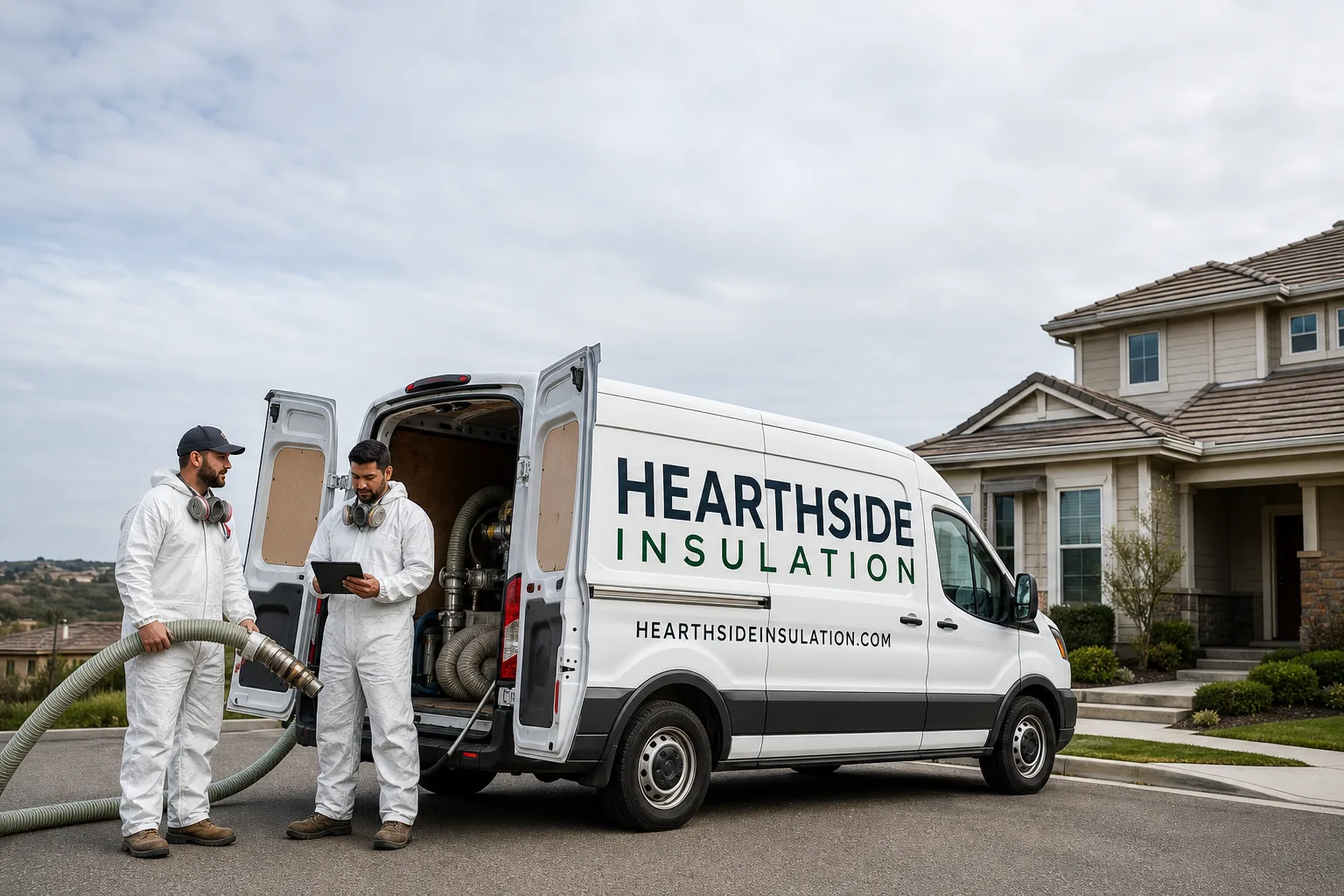
Fast, Reliable Spray Foam Insulation Across Portola Hills
Spray foam insulation in Portola Hills costs roughly $2.50 to $6.50 per board foot installed, with most whole-attic open-cell jobs in the 92610 ZIP landing between $3,200 and $7,800 depending on square footage and depth. That’s the direct answer. But what matters more in Portola Hills is *why* the foam is going in. Up here against the Cleveland National Forest edge, a spray foam job is rarely just a thermal upgrade. It’s air-sealing that has to hold against Santa Ana gusts, resist ember intrusion, and still let your attic breathe the way a 1980s tract home was designed to. Our crews know the difference because we work these foothill neighborhoods constantly. Call (877) 265-4871 and we’ll give you a straight answer on what your home actually needs.
Why Hearthside Insulation Is Portola Hills’s Preferred Spray Foam Insulation Company
Hearthside Insulation is a dedicated insulation contractor, not a generalist crew picking up foam work on the side. That distinction matters in Portola Hills because the homes here sit at the wildland-urban interface. A correct spray foam application along Saddleback Ranch Road or up off Ridgeline Drive involves fire-severity awareness, vent screening decisions, and adhesion work against wood-frame stucco that’s been baking and cooling through thirty-plus years of foothill temperature swings. We carry both Icynene and Demilec spray foam systems, which means we can give you an honest open-cell versus closed-cell comparison for your specific attic or rim joist condition rather than selling whatever single product we happen to stock. Homeowners in Portola Hills consistently tell us the same thing: they called around, got three different product pitches, and then found us explaining tradeoffs in plain English. That’s the job.
Our Spray Foam Insulation crews are in Portola Hills weekly. Response time for a standard attic estimate is usually next day. For a storm-prep or post-wind inspection, we’ll do what we can to be there same day when the schedule allows. Trevor Bassett, who runs Hearthside, built the company around one principle: match the material to the application, not the other way around. That’s why we’re authorized to install products from eight manufacturers including Johns Manville, Rockwool, and CertainTeed, and why we don’t have a preferred-product quota pushing you toward foam when cellulose or mineral wool might be the better fit for a given cavity.
Open Cell Spray Foam in Portola Hills
Open Cell Spray Foam is the workhorse for Portola Hills attics where the goal is air-sealing, sound dampening, and a solid R-value per dollar. The foam expands into cavities with a soft, sponge-like structure that stops air movement through top plates, wiring penetrations, and recessed can lights. In Portola Hills, this is the material we most often recommend for interior attic roof decks and knee-wall cavities in the 1980s and 1990s tract homes that dominate the 92610 housing stock. The payback comes from shutting down the stack effect that pulls hot afternoon air into the living space and pushes conditioned air out through gaps that have been open for decades. Typical open-cell attic work in Portola Hills runs $3,200 to $6,100 depending on depth and layout.
Air-Sealing First, Foam Second
Open-cell foam does its best work when the attic has been prepped correctly. Before we spray anything, we walk the entire attic floor and eaves looking for the gaps that matter most: top plates, wire chases, vent pipe penetrations, and can light housings. In Portola Hills, we also check every gable vent and eave screen because Santa Ana winds turn a missing screen into an open doorway for embers and debris. Sealing those openings before foam application is what turns a thermal upgrade into a fire-season upgrade.
When Open Cell Makes Sense vs. Closed Cell
Open-cell is typically half to two-thirds the cost of closed-cell per board foot, and for an interior attic deck that’s fully protected from weather, it usually delivers the right balance of performance and cost. Where Portola Hills homes differ from coastal cities is the wind. If a portion of the assembly will be exposed to wind-driven rain or direct ember contact, we’ll steer you toward closed-cell or a hybrid approach. The honest answer starts with a site inspection, not a product pitch.
Spray Foam Insulation Contractors in Portola Hills
Spray Foam Insulation Contractors in Portola Hills are not all the same, and we say that without needing to put anyone else down. The difference is specialization. Hearthside does insulation work exclusively. That means when our crew shows up to a home off Glenn Ranch Road or up toward the fire station, the spray foam rig, the prep work, and the crew’s entire skill set are built around thermal and air-sealing performance. We’re not an HVAC contractor fitting in a foam job between furnace installs. We carry both Icynene and Demilec systems, so the open-cell versus closed-cell conversation on your project is driven by your house, not by what’s on our truck. Typical project pricing for full spray foam contractor work in Portola Hills ranges from $4,500 to $11,000, with the spread driven by square footage, accessibility, and whether the job includes rim joist or roof deck work.
Rim Joist and Garage Ceiling Work
Foothill homes built in the 1980s and 1990s frequently have rim joist cavities that were never sealed, which means cold canyon air moves through the floor system every night. Spraying closed-cell foam into the rim joist band along the foundation is one of the most cost-effective upgrades we do in Portola Hills. We see the same story in attached garages, where the ceiling is effectively the floor of a bedroom or bonus room. Two to three inches of closed-cell on a garage ceiling changes the comfort of the room above within a day.
The Portola Hills Difference
We treat every foam job in Portola Hills as a wind-and-ember job first and a thermal job second. That’s not how we’d frame a job in Lake Forest or Mission Viejo, and it’s exactly why the distinction matters. The building envelope here has to answer to the Cleveland National Forest edge. Our prep work includes screening checks, eave gap sealing, and an honest look at whether the existing attic ventilation design is safe before we add an air-sealing foam layer.
Trusted Brands We Service in Portola Hills
Hearthside is authorized to install spray foam systems from both Icynene and Demilec, two of the most respected names in the category. That dual access means we can quote open-cell and closed-cell options without a bias toward one manufacturer. We also work across the broader insulation spectrum with brands like Owens Corning, Johns Manville, Knauf, Rockwool, CertainTeed, and GreenFiber, so when a Portola Hills homeowner needs mineral wool for fire-rated assemblies or cellulose for a blown-in retrofit, we’re not reaching for the nearest foam canister. The right material for the cavity, the assembly, and the fire-severity zone: that’s the standard.
Common Spray Foam Insulation Problems We See in Portola Hills Homes
- Ember and debris intrusion through unscreened vents: Santa Ana gusts push wind-driven leaves, pine needles, and occasionally embers through gable vents and eave gaps. We routinely find debris packed against spray foam edges where a missing screen created an ignition risk right at the foam line.
- Condensation and adhesion failures from temperature swings: Portola Hills sees hot foothill afternoons followed by cool canyon nights. When open-cell foam was applied over a substrate that wasn’t prepped or when the cavity wasn’t conditioned, those swings can cause condensation at the foam-to-wood interface and eventual adhesion loss.
- Foam applied without fire-severity detailing: A foam-sealed attic that still has unscreened vents or exposed combustible details doesn’t meet the practical standard for a home on the Cleveland National Forest edge. The foam is doing its thermal job while the assembly fails the fire-severity job.
- Undersized or blocked attic ventilation after air-sealing: Air-sealing is good, but it changes the attic’s moisture equation. In Portola Hills homes with original 1980s vent configurations, we see foam jobs that sealed the house tight without upgrading intake or exhaust ventilation, leading to moisture buildup under the tile roof deck.
Pricing for Spray Foam Insulation in Portola Hills, CA
Here are the numbers we quote most often in Portola Hills. Open-cell attic roof deck work: $3,200 to $6,100. Closed-cell attic or roof deck work: $5,800 to $11,000. Rim joist sealing: $900 to $2,400 depending on linear footage and access. Garage ceiling spray foam: $1,200 to $3,000 for a standard two-car attached garage. A hybrid job combining open-cell in the attic with closed-cell at rim joists and garage ceilings typically lands between $5,000 and $9,500. What moves the price? Square footage, foam depth, access difficulty, and whether we’re doing fire-severity prep work like vent re-screening and eave sealing. Estimates are free. Call (877) 265-4871 and we’ll give you a number you can plan around.
We Also Serve Cities Near Portola Hills
Hearthside runs crews into Portola Hills and the surrounding foothill and canyon communities every week. If you’re in Foothill Ranch, Lake Forest, Mission Viejo, or Trabuco Canyon, we can usually schedule an estimate within a day or two. Learn more about our full coverage area here: Spray Foam Insulation in Portola Hills.
Serving Portola Hills, CA — Our Local Coverage Area
We’re based in the Portola Hills area and know this community well. Use the map below to see our service coverage — if you’re nearby, we can almost certainly help.
FAQs About Spray Foam Insulation in Portola Hills
Yes. Portola Hills sits within a state-designated high fire-severity zone, and any spray foam assembly here should be evaluated against ignition-resistant detailing requirements, including ember-resistant vent screening and eave gap sealing. Foam itself is not the weak point; the vents and gaps around it are. Call (877) 265-4871 and we’ll walk your attic with you before any foam goes in.
Santa Ana winds do two things to a Portola Hills foam job. They force wind-driven debris and embers through unscreened attic and eave vents, packing material against foam edges, and they drive pressure differentials that make air leaks more pronounced. Our prep work always includes a vent screening inspection and eave gap check before spraying. A foam job that ignores the wind is a foam job that fails early.
For most interior attic decks in the 1980s and 1990s wood-frame stucco tract homes that make up Portola Hills, open-cell delivers the right performance per dollar. Closed-cell becomes the better choice when the cavity faces wind-driven weather exposure, ember risk, or you need structural racking strength at the roofline. We carry both Icynene and Demilec systems, so the recommendation comes from your assembly, not our inventory. Call (877) 265-4871 for a straight comparison.
No. Spray foam seals and insulates; it does not repair or replace a vent. If your gable vent has lost its screening or your eave vents are clogged with wind-blown debris, those issues need to be addressed before or alongside the foam. Our standard Portola Hills prep includes ignition-resistant vent re-screening and eave gap sealing as part of the project scope.
We install spray foam systems from Icynene and Demilec, two manufacturers with deep reputations in open-cell and closed-cell chemistry. That dual access means you’re getting a brand recommendation matched to your Portola Hills home’s condition, not a one-brand pitch. Trev and the crew also work with complementary materials from Owens Corning, Johns Manville, Knauf, Rockwool, CertainTeed, and GreenFiber when the job calls for a mixed-material approach.
Have a question we didn’t answer? Call (877) 265-4871 and ask for Trevor. He’ll give you the real story on spray foam in Portola Hills, no script.
Written by Trevor Bassett, Owner at Hearthside Insulation, serving Portola Hills and the surrounding foothill communities.