
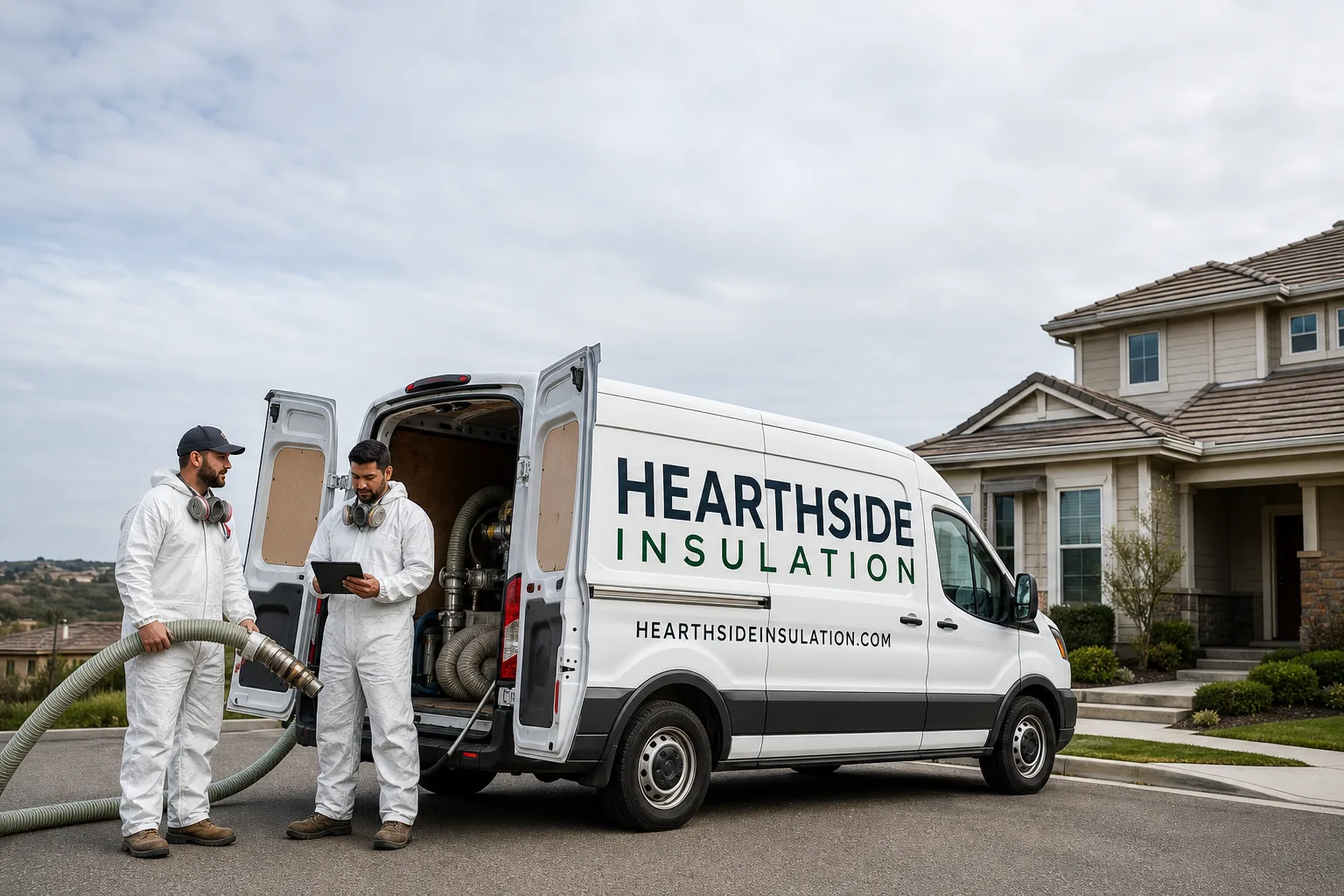
Fast, Reliable Spray Foam Insulation Across Eastvale
Spray foam insulation in Eastvale typically costs $2.50 to $7.50 per square foot installed, with most whole-attic open-cell projects in the 92860 ZIP landing between $3,500 and $8,500 depending on square footage, ceiling height, and how much of the original builder fiberglass has to come out first. We run crews to Eastvale from Foothill Ranch most weeks, so a site visit and a same-day quote are almost always possible without a long wait. If you’re in one of the newer tracts off Archibald, Scholar Way, or Hamner Avenue and you’re tired of upstairs rooms baking through July and August, call (877) 265-4871 and we’ll walk the attic with you.
Why Hearthside Insulation Is Eastvale’s Preferred Spray Foam Insulation Company
Eastvale homeowners call us because the insulation problems in this city are specific and repeatable. Nearly every house here went up after 1998, and nearly every one got the same builder treatment: R-13 batts in the walls, R-19 blown or batted fiberglass over the ceiling, and very little attention paid to the places where those runs get interrupted. We know exactly where those interruptions are in Eastvale plans because we see them every week. The garage-side attic hatch with sagging batts around it. The fire-sprinkler risers that punch through the ceiling plane and leave gaps. The HVAC plenum chase that got stuffed with whatever scrap was left on the truck that day.
Trevor Bassett started Hearthside Insulation to run an insulation-only shop, not a general contracting crew doing insulation on the side. That focus shows up in the details Eastvale homeowners ask about: we match the material to the ceiling assembly, the roof pitch, and the cooling-season load, not to whatever product we happen to have the best margin on this month. We carry both Icynene and Demilec open-cell and closed-cell systems, so you get a real comparison instead of a sales pitch for one can of foam. And because we install across eight brands including Owens Corning, Johns Manville, Knauf, Rockwool, CertainTeed, and GreenFiber, we’ll tell you honestly when spray foam isn’t the right call and blown-in cellulose or mineral wool makes more sense for your attic.
Open Cell Spray Foam in Eastvale
Open cell spray foam in Eastvale is the most common spray application we install because it fits the attic geometry of the city’s two-story stucco tract homes. On a typical Eastvale ceiling plane with low-slope concrete tile above, open cell expands to fill the cavity between ceiling joists and then cures into an air-sealing, insulative blanket that stops the stack of heat that builds up under the tile from driving into the bedrooms below. We spray it across the underside of the roof deck or directly against the ceiling plane depending on whether you have ductwork up there and whether you want the attic semi-conditioned. Most Eastvale jobs run $2.50 to $4.50 per square foot for open cell, and the bigger variable is prep: if we have to pull out compressed builder fiberglass first, the labor cost goes up but the improvement is dramatic.
Where Open Cell Fits Best in the 92860
Open cell is the right material for most Eastvale attics because this city’s problem is heat gain, not groundwater or heavy condensation. The foam’s air-sealing property is what does the real work. A batt can have an R-value printed on the bag and still let 100-degree attic air slip around its edges, but open cell expands against the framing and seals those leak paths as it cures.
For Eastvale homeowners with second-story bedrooms that run 8 to 12 degrees hotter than the downstairs in summer, open cell across the ceiling plane typically closes that gap faster than adding more fiberglass ever could. We also spray open cell into rim joist cavities and around the garage ceiling when the living space sits directly above the garage. That’s a common Eastvale complaint: a bonus room over the garage that never cools down.
What the Job Actually Involves
We’ll do a real walkthrough first, not just a square-footage number over the phone. Our crew needs to see the attic hatch, the sprinkler risers, the duct layout, and whether the builder left any batts worth keeping. Prep usually takes half a day. The spray itself typically finishes in a single day for most Eastvale two-story homes, and we mask off everything below the hatch to keep overspray out of the living space.
After it cures, we check the hatch perimeter, the plenum chase, and the riser penetrations with a thermal camera. If we find any thin spots, we touch them up before you ever have to ask.
Spray Foam Insulation Contractors in Eastvale
Spray foam insulation contractors in Eastvale don’t all know what these newer tract homes look like inside the attic, and that’s the difference you’re paying for. The plans in most Eastvale neighborhoods have specific trouble spots that only show up when you’ve worked enough attics to expect them. The hatch. The sprinklers. The duct chases. A generalist crew might spray over those gaps without sealing them first, and the foam would just trap the same thermal bypasses inside its envelope. We find and seal the interruptions before the foam goes in. That sequence, sealing first and spraying second, is the single biggest quality variable on Eastvale spray foam jobs.
What does it cost to use us instead of whichever crew bid the job cheapest? For most Eastvale open-cell applications, $3.50 to $5.50 per square foot all-in including prep, sealing, spraying, and cleanup. Closed cell runs higher, $5.50 to $7.50 per square foot, and we don’t usually recommend it over open cell in Eastvale attics unless you need the structural racking strength or you have a roof deck application with limited cavity depth. Our estimates are free, and we’ll walk you through why we recommend the material we recommend for your specific house, not just the average house.
Sealing the Bypasses First
On a two-story tract home off Hamner Avenue in the 92860 ZIP, our crew pulled the garage-side attic hatch and found the original builder fiberglass batts compressed and gapped around the fire-sprinkler risers and the HVAC plenum chase. We sealed those interruptions and sprayed open cell across the ceiling plane to close the thermal bypasses the builder left behind, and the upstairs rooms stopped baking through the 100-degree afternoons. That’s the order it has to happen in. The foam is only as good as the prep underneath it.
When we see an Eastvale attic where someone already sprayed foam without sealing first, the tell is usually a warm stripe along the ceiling near the hatch or the garage wall. The foam looks fine from below, but the gap behind it is still breathing.
Why the Builder-Grade Fiberglass Has to Go
Most Eastvale homes were built with R-13 or R-19 fiberglass from the late 1990s through the 2010s, and Title 24 expectations have moved well past that. A 10-year-old house in the master-planned tracts can already be under-insulated by current standards. That’s not the house falling apart. It’s just what the builder was allowed to install at the time. Spray foam upgrades in Eastvale are almost always an upgrade over that original fiberglass rather than a retrofit of an older house.
We don’t always remove every batt. If some of the fiberglass is clean and uncompressed, we can spray open cell against the ceiling plane and leave it in place. But if it’s gray with dust, compressed around risers, or sagging at the hatch, it’s doing less than half its rated R-value. Then it comes out.
Trusted Brands We Service in Eastvale
We’re authorized to install Icynene and Demilec spray foam systems, which means Eastvale customers get an honest open-cell versus closed-cell comparison instead of a single-product pitch. We also carry Johns Manville and Knauf fiberglass for jobs where spray foam isn’t the best fit, and Rockwool mineral wool for homeowners who want fire resistance and sound attenuation along with thermal performance. That breadth matters in Eastvale because no two attics in this city are exactly alike, even in the same tract. Some need foam across the whole ceiling plane. Some need mineral wool around the garage and cellulose in the attic. The right material is the one that matches your ceiling assembly and your cooling bill, not the one we happen to stock the most of.
Common Spray Foam Insulation Problems We See in Eastvale Homes
- Compressed builder batts around fire-sprinkler risers. California’s newer residential codes require fire sprinklers, and in Eastvale’s tracts the risers punch right through the ceiling plane. The original fiberglass was often stuffed or cut around them, and the gaps kill the effective R-value right where the thermal boundary matters most.
- Garage-side attic hatches interrupting the insulation run. The hatch itself is rarely insulated in these homes, and the batts around it sag or go missing. Attic heat pours through the hatch and into the hallway or bedroom adjacent to the garage.
- HVAC plenum chases with loose fill blown around them. The tightly packed HVAC platforms in two-story Eastvale plans leave very little room for insulation around the ducts. Whatever fits got installed, and whatever didn’t fit just didn’t get covered.
- Spray foam shot over unsealed gaps. If a previous contractor sprayed open cell over the top of existing bypasses without sealing them first, the thermal leaks are now permanently baked into the envelope. The only fix is cutting back the foam, sealing the gap, and respraying.
Pricing for Spray Foam Insulation in Eastvale, CA
Open cell spray foam in Eastvale runs $2.50 to $4.50 per square foot for most ceiling-plane and attic applications. Closed cell runs $5.50 to $7.50 per square foot and we’ll only recommend it when the job calls for it: roof decks with limited depth, high-moisture areas, or structural racking needs. A typical two-story Eastvale home with a 1,200 to 1,800 square foot attic will land between $4,200 and $8,100 for open cell, and prep work like removing compressed fiberglass or sealing riser penetrations adds labor on top of the spray itself. Rim joist and garage ceiling spray jobs run $1,800 to $3,500 depending on access and linear footage. The honest answer is that your Eastvale home has specific geometry, and the only way to price it accurately is to get someone in the attic. Estimates are free. Call (877) 265-4871 and we’ll come out with a thermal camera and a measuring wheel.
We Also Serve Cities Near Eastvale
Our crews regularly run jobs in Eastvale and the surrounding Riverside County cities. If you’re in Norco, Home Gardens, Corona, or Jurupa Valley, we cover those areas too. Same materials, same prep standards, same crew. If you want to know more about what we do, start with our Spray Foam Insulation service page for the full breakdown.
Serving Eastvale, CA — Our Local Coverage Area
We’re based in the Eastvale area and know this community well. Use the map below to see our service coverage — if you’re nearby, we can almost certainly help.
FAQs About Spray Foam Insulation in Eastvale
Because most Eastvale homes were built with R-13 or R-19 builder-grade fiberglass, and current Title 24 expectations are well past that threshold. The house isn’t falling apart; it was under-insulated from day one, and a decade of 100-degree Riverside County summers has made the gap obvious. Spray foam’s air-sealing property is what closes the gap fast. Call (877) 265-4871 and we’ll show you exactly where your attic is losing ground.
Compressed, gapped, or missing fiberglass. The fire-sprinkler risers in newer Eastvale homes punch through the ceiling plane, and the original batts were cut or stuffed around them. The garage-side attic hatch almost always has sagging batts around the perimeter. We seal those interruptions before we spray, because foam over a gap is just an expensive way to keep the gap warm.
Yes, and for a specific reason: fiberglass slows conductive heat but does nothing to stop the air movement that carries hot attic air around the edges of batts. Open cell spray foam expands against the framing and seals those leak paths. In Eastvale’s summer heat, the air-sealing alone typically outperforms adding more fiberglass on top of existing batts. Call us for a thermal camera walkthrough and we’ll show you the difference in your own attic.
Yes. The platforms in many Eastvale two-story homes leave very little clearance around the ducts, and blown-in or batted insulation doesn’t fit well in those cavities. Spray foam does. We apply it carefully around the plenum and ductwork without blocking service access, and we seal the chase before spraying so the thermal envelope stays continuous.
For open cell, you’ll usually want to be out of the house for 12 to 24 hours while the foam cures and the odor dissipates. Closed cell has a shorter re-entry window, typically 2 to 4 hours after spraying. We’ll go over the exact timing for your specific job before we schedule the crew, and we mask off everything below the attic hatch to keep overspray contained.
Written by Trevor Bassett, Owner at Hearthside Insulation, serving Eastvale, CA and surrounding Riverside County communities.