
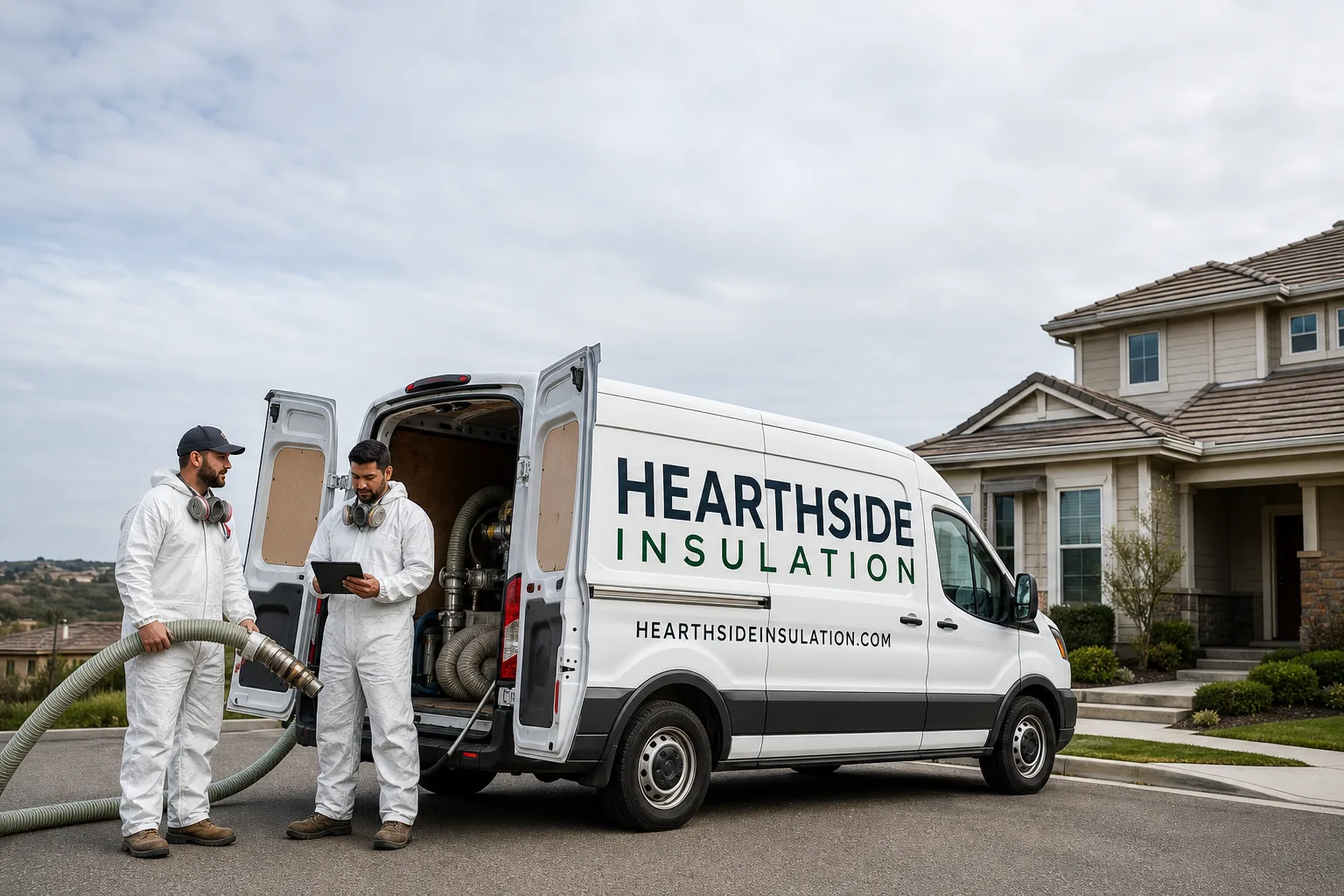
Fast, Reliable Spray Foam Insulation Across Corona
Spray foam insulation in Corona typically costs $2,800 to $7,400 for a full attic application, with crawl spaces running $1,600 to $4,200 and garage ceilings $900 to $2,300. Most Corona jobs are completed in one day. Why the wide range? Because Corona sits across three distinct microclimates, and the right foam specification for a foothill home in 92883 isn’t the same as what works on the valley floor in 92882. Hearthside Insulation has been sealing and insulating Corona homes with both Icynene and Demilec spray foam systems, and we match the material to your house, your ZIP code, and your actual heat gain problem. Call (877) 265-4871 for a free estimate, and we’ll walk your attic before we quote anything.
Why Hearthside Insulation Is Corona’s Preferred Spray Foam Insulation Company
Corona homeowners keep calling us after a general contractor quotes them fiberglass and calls it a day. Insulation is all we do. That focus means we can tell you exactly why the original builder batts in your 1980s stucco tract home have failed and which spray foam system fixes it, without trying to upsell you an HVAC replacement or a reroof. We carry both Icynene and Demilec spray foam lines, which matters more in Corona than almost anywhere else. Foothill homes, valley floor homes, and Santa Ana wind corridor homes each need different air-sealing details, and our access to two respected manufacturers means we pick the honest fit instead of steering you toward whatever’s on the truck.
Our Spray Foam Insulation specialists know the housing stock here: 1970s – 2000s tract builds, stucco-clad developments in 92879 and 92882, original builder-grade fiberglass in attics with minimal wall insulation. We’ve worked in every corner of Corona, from the flat streets off Main Street to the slope-side homes along the 91 corridor. Local knowledge matters when you’re specifying open-cell versus closed-cell foam based on whether your attic sits in the hot valley inversion layer or catches the afternoon foothill drafts. And yes, we offer same-day and next-day availability for Corona homeowners because triple-digit heat doesn’t wait for a convenient scheduling window.
Crawl Space Spray Foam Insulation in Corona
Crawl Space Spray Foam Insulation in Corona homes means sealing the floor joists and rim joists against the dry, hot air that gets pulled into the crawl space every afternoon when the inland valley heats up. In the 92882 and 92879 ZIPs, we see the same pattern repeatedly: open crawl vents that were standard practice in the 1980s and 90s, exposed fiberglass batts that have drooped or fallen completely, and daylight visible at the rim joist where the floor framing meets the foundation. That’s a direct path for outside air into your living space.
A typical crawl space encapsulation with closed-cell spray foam on the rim joists and walls runs $1,600 to $4,200 in Corona depending on square footage, access height, and whether we’re also sealing the dirt floor with a vapor barrier. Closed-cell Demilec foam is the usual recommendation here because it doubles as both air barrier and vapor retarder, which matters in crawl spaces that sit against Coronas dry, cracked summer soil. The work usually takes a single day.
Rim Joist Air Sealing
The rim joist is the single biggest air leak in most Corona crawl spaces. We remove the failed fiberglass, rake out the debris, and spray closed-cell foam across every bay. This stops the hot-air draw and cuts the stack effect that was pulling conditioned air out of your upper floors. In homes off Ontario Avenue and along Lincoln, this fix alone typically drops crawl space temperatures by 15 to 20 degrees in summer.
Open-Cell Floor Insulation
When the crawl space itself stays dry and ventilated, open-cell Icynene floor insulation makes more sense. Lighter and denser per dollar than closed-cell, it fills the joist cavities and quiets foot traffic noise while providing roughly R-3.7 per inch. We use it when the goal is comfortable floors, warmer in winter, cooler in summer, without the full encapsulation project.
Garage Spray Foam Insulation in Corona
Garage Spray Foam Insulation in Corona is one of the most requested upgrades we do because so many homes here have an attached garage that bakes in the afternoon sun, transferring heat straight into the adjacent living room or bedroom wall. The garage ceiling and the shared wall between garage and house are the two places a Corona homeowner sees the fastest return. An uninsulated garage in August can exceed 120 degrees, and that heat doesn’t just stay in the garage, it radiates through the common wall for hours after sunset.
A garage ceiling spray foam job in Corona ranges $900 to $2,300 depending on whether the ceiling is already drywalled, how many penetrations need sealing, and whether we’re also doing the garage door and side walls. Most jobs finish in a half day. We use open-cell Icynene on garage ceilings when the goal is temperature control and noise reduction, and closed-cell Demilec when the garage has living space above it and we need the vapor control.
Garage Cap Insulation
The garage cap, that flat section of exterior wall above the garage door and below the roof line, is rarely insulated in 1980s and 90s tract construction. We see this constantly in 92877 and 92878. Foaming the cap cavity stops the early-morning heat load that hits the garage before the sun ever reaches the roof deck.
Garage Ceiling Roof Deck Retrofit
When the garage has no attic above it and the roof deck is directly exposed, we spray foam directly to the underside of the roof sheathing. That turns the garage into a conditioned space and blocks the radiant heat before it ever enters the volume of the garage. For Corona homeowners with a bedroom above the garage, this is often the single most effective upgrade available.
Trusted Brands We Service in Corona
Hearthside Insulation is authorized to install spray foam from both Icynene and Demilec, two names that carry a lot of weight in building science circles. We also work with Owens Corning, Johns Manville, and Rockwool products for Corona homes where a hybrid approach, spray foam air sealing plus mineral wool batt in select cavities, makes more sense than foam everywhere. We keep our supply chain direct to manufacturer, so Corona customers aren’t waiting on a distributor in LA county to restock. Fast turnaround on foam, board, and sealing materials means your garage or crawl space gets done when we said it would.
Common Spray Foam Insulation Problems We See in Corona Homes
- Failed original fiberglass in 1980s – 90s stucco homes. In ZIPs like 92879 and 92882, the builder-grade batts have sagged and separated from framing after thirty years of triple-digit heat cycling. The convection loop this creates makes upstairs rooms feel like ovens even when the AC runs nonstop.
- Uneven settling in foothill ZIP 92883. The thermal draft off the nearby hills pushes air through attic vents differently than on the valley floor. Blown-in insulation drifts and settles, leaving bare spots nobody sees until the electric bill lands.
- Santa Ana wind-driven attic penetration leaks. Valley floor homes catch hot, dry air forced through unsealed top plates and recessed light fixtures every Santa Ana event. Insulation alone won’t fix this, the air path has to be sealed first.
- Garage-to-bedroom heat transfer. So many Corona floor plans put a bedroom over the garage or share a wall with it. The garage cap and shared wall were rarely insulated when the house was built, and decades later the fix is still uncommon, until we open the wall and foam it properly.
Pricing for Spray Foam Insulation in Corona, CA
Here’s whatCorona homeowners should expect to pay. Attic spray foam, full roof deck application, runs $2,800 to $7,400 depending on the roof’s square footage and whether you have open rafters or a drywalled ceiling. Crawl space encapsulation, $1,600 to $4,200. Garage ceiling with shared wall, $900 to $2,300. Rim joist only, $800 to $1,900. Open-cell foam costs less per board foot than closed-cell but requires more inches to hit the same R-value. In Corona’s climate, we often recommend closed-cell on the roof deck and open-cell in walls and garage ceilings. The honest answer is that the right material depends on your ZIP, your house’s framing, and where the heat is actually coming in. We give you a firm quote before we start, free of charge. Call (877) 265-4871 and we’ll come look at your attic, not guess over the phone.
We Also Serve Cities Near Corona
Our crews cover the surrounding communities as well: Home Gardens, El Cerrito Corona, Eastvale, and Norco. If you’re just over the city line and wondering whether we make the drive, the answer is yes. We schedule Corona and its neighboring ZIP codes daily, so your timeline doesn’t stretch just because you’re half a mile outside city limits. Call (877) 265-4871 to check our current schedule.
Serving Corona, CA — Our Local Coverage Area
We’re based in the Corona area and know this community well. Use the map below to see our service coverage — if you’re nearby, we can almost certainly help.
FAQs About Spray Foam Insulation in Corona
Spray foam outperforms fiberglass in 92882 because those 1980s and 90s stucco homes were built with fiberglass batts that have already failed. Foam air-seals as it insulates, so the convection loops and Santa Ana wind penetration that plague older tract homes get addressed in the same pass. Fiberglass only slows conductive heat transfer if it stays perfectly in place, which in Corona’s heat cycling it rarely does after 20 or 30 years.
We remove the settled blown-in material, air-seal the attic floor penetrations, and re-insulate with spray foam that bonds to the surface it’s applied to. The thermal draft off the hills near the 91 corridor won’t shift adhered foam the way it drifted loose-fill. For foothill homes with existing good blown-in coverage, we can also add targeted foam sealing at the eaves and ridge to stop the draft paths without a full tear-out.
Yes, and it’s the single most effective retrofit available for attic temperature control. A closed-cell foam application to the underside of a roof deck in a Corona valley floor home can reduce attic temperatures by 30 to 40 degrees on a 105-degree afternoon. That means your HVAC runs shorter cycles, your upstairs rooms hold temperature, and your ductwork isn’t baking in a 140-degree attic. Call (877) 265-4871 to have us measure your attic before deciding.
Crawl space foam addresses the stack effect drawing hot, dry outside air up through your floor framing. Garage foam addresses radiant gain through the garage cap, ceiling, and shared wall that heats adjacent rooms. Which one you need depends on where your discomfort actually is. We diagnose both during a free estimate, and we won’t sell you a crawl space job if your real problem is a garage ceiling that hasn’t been sealed since the house was built.
No, closed-cell spray foam on the roof deck makes a radiant barrier redundant because the foam blocks the heat path entirely. A radiant barrier reflects radiant heat but does nothing for conduction or air leakage. Foam handles all three. If you already have open-cell foam and still feel heat gain through the roof in Corona’s hottest months, adding a radiant barrier can help, but the better fix is adding closed-cell to the sun-facing roof slopes.
Written by Trevor Bassett, Owner at Hearthside Insulation, serving Corona and the surrounding communities.